Données astronomiques
Lever
07:30
Midi solaire13:44
Coucher
19:59
Premier quartier
46 % éclairée
Durée du jour
12h 29min -3min 33s
Crépuscule civil
06:59 - 20:29
Heure dorée
18:59 - 19:59
Ciel à observer
Prochain rendez-vous céleste : Maximum des Orionides, le 21 octobre (jusqu'à 20 météores par heure), dans 33 jours
Image astronomique du jour
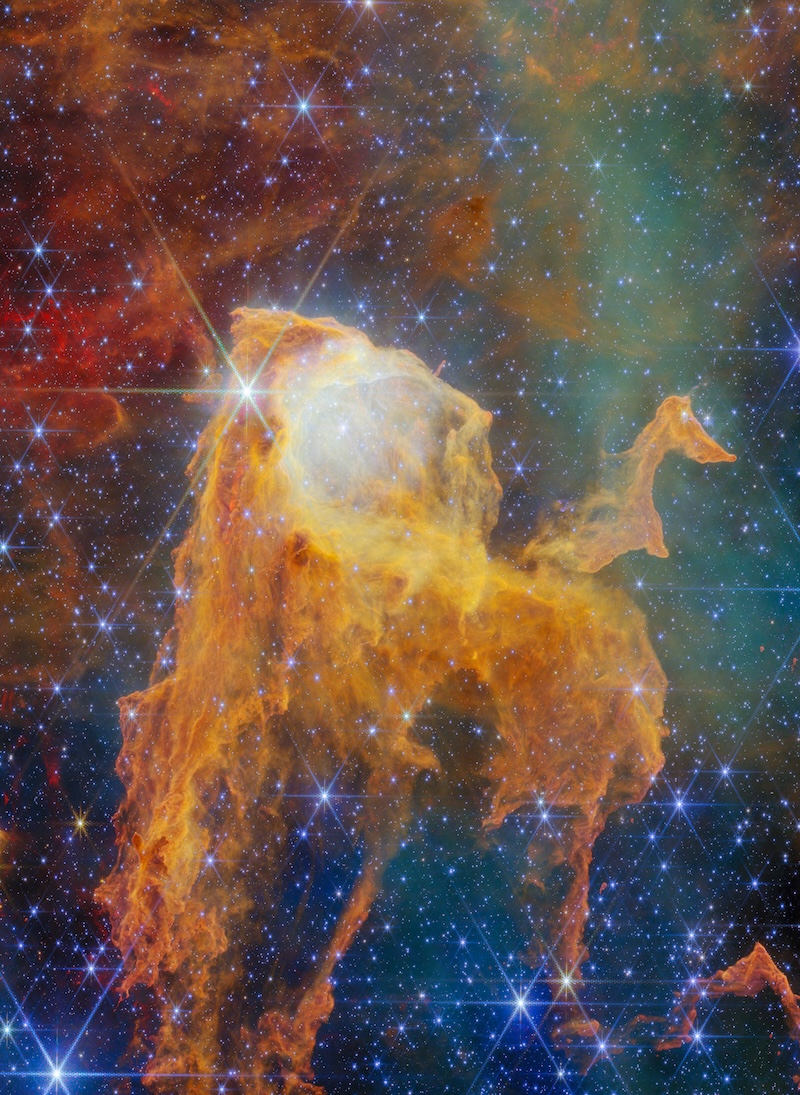
A Treasure Chest in the Carina Nebula
NASA APOD · ESA/Webb, NASA & CSA, M. Reiter; Acknowledgement: M. H. Özsaraç
Text:
Cecilia Chirenti
(NASA
GSFC,
UMCP,
CRESST II)
Le texte de la NASA (anglais)
This treasure chest is full of stars. The featured image was obtained with NASA's James Webb Space Telescope and shows a dust pillar in the Carina Nebula inside our Galaxy, roughly 7500 light-years away. It is formed by interstellar gas and dust, and shaped by powerful stellar winds and radiation form neighboring stars like the nearby Eta Carinae stellar system which is more luminous than 5 million suns. The star formation inside the pillar is excavating its head, creating the open lid of the chest. Astronomers estimate that there are about 70 stars in a compact cluster inside the pillar. This cluster is now thought to be only around 1.3 million years old. Its bounty of young stars includes a massive star approximately 19 times as massive as the Sun. More massive stars are rarer, shine brighter and evolve faster than less massive stars. They are the shiniest jewels in the treasure chest. APOD's main NASA site is moving : From apod.nasa.gov to science.nasa.gov/apod
Lire sur apod.nasa.gov