Éphéméride Chaque jour a son histoire

Éphéméride astronomique du jour

Données astronomiques

Soleil
Lever
08:40
Coucher
17:15
Durée du jour 8h 35min (+1min 39s) Midi solaire 12:57 Crépuscule civil 08:05 — 17:49 Heure dorée 16:15 — 17:15
Lune
Gibbeuse décroissante — 09/01/2026
Gibbeuse décroissante
Illumination : 62%

Ciel à observer

En activité

Quadrantides

L'une des pluies les plus intenses de l'année, mais au maximum très bref (quelques heures). Son nom vient du Quadrant mural, une constellation aujourd'hui disparue des cartes du ciel.

Activité déclinante après le maximum de la nuit du 3 au 4 janvier · jusqu'à 110 météores par heure · radiant dans le Bouvier, regarder vers le nord-est · poussières de l'astéroïde (196256) 2003 EH1.
Prochain rendez-vous céleste : Maximum des Lyrides, le 22 avril (jusqu'à 18 météores par heure) — dans 103 jours

Image astronomique du jour

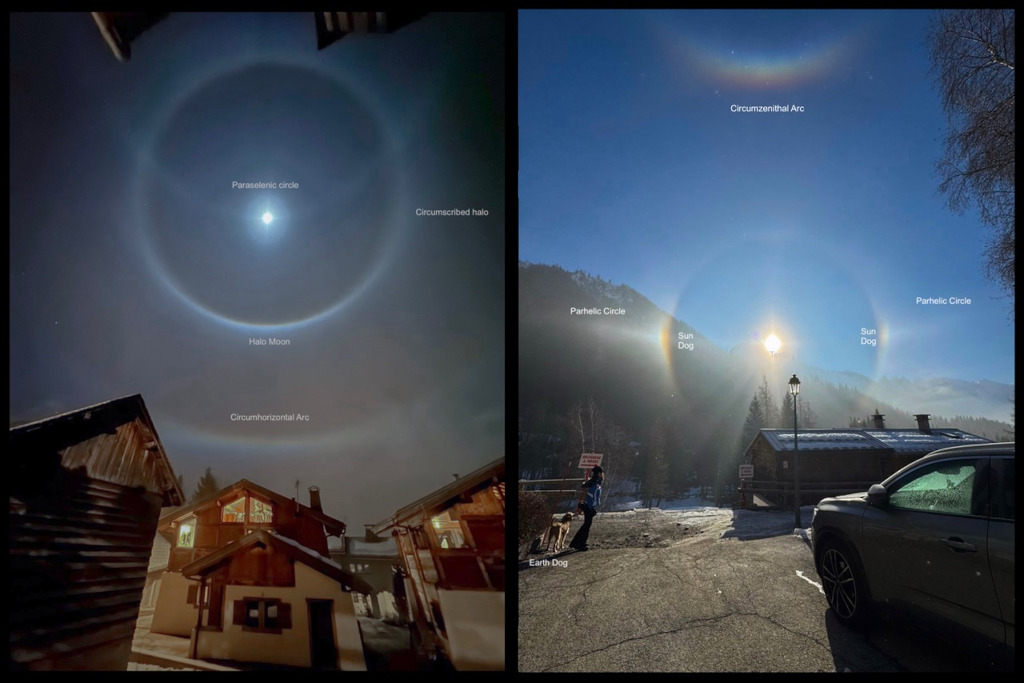
Ice Halos by Moonlight and Sunlight

Ice Halos by Moonlight and Sunlight

Both Moon and Sun create beautiful ice halos in planet Earth's sky. In fact, the two brightest celestial beacons are each surrounded by a complex of ice halos in these photos of the sky above Chamonix-Mont-Blanc in France. The panels were recorded one night (left) and the following day at the end of December 2025. Similar ice halos appear in moonlight and sunlight because they are all formed through the geometry of flat, hexagonal ice crystals. The ice crystals reflect and refract light as they flutter in the cold atmosphere above the mountain resort. In the pictures both Moon and Sun are surrounded by a more commonly seen 22 degree circular halo. Bright and sometimes colorful patches at the intersections of the 22 degree circular halos with the indicated parselenic and parhelic arcs are also known as Moon dogs and Sun dogs. (Editor's note: Annotations updated by Marcella Pace)

Crédit : ice halos