Données astronomiques
Lever
08:36
Midi solaire12:59
Coucher
17:23
Dernier croissant
11 % éclairée
Durée du jour
8h 46min +2min 5s
Crépuscule civil
08:02 - 17:57
Heure dorée
16:23 - 17:23
Ciel à observer
Prochain rendez-vous céleste : Maximum des Lyrides, le 22 avril (jusqu'à 18 météores par heure), dans 97 jours
Image astronomique du jour
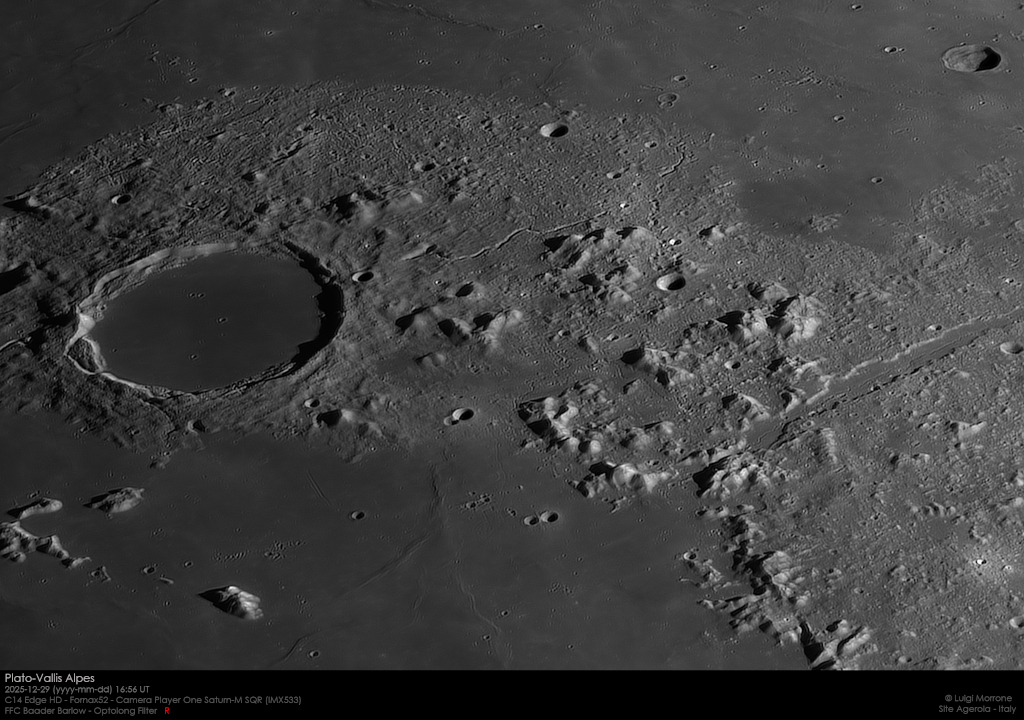
Plato and the Lunar Alps
NASA APOD · Luigi Morrone
Le texte de la NASA (anglais)
The dark-floored, 95 kilometer wide crater Plato and sunlit peaks of the lunar Alps (Montes Alpes) are highlighted in this this sharp telescopic snapshot of the Moon's surface. While the Alps of planet Earth were uplifted over millions of years as continental plates slowly collided, the lunar Alps were likely formed by a sudden collision that created the giant impact basin known as the Mare Imbrium or Sea of Rains. The mare's generally smooth, lava-flooded floor is seen below the bordering mountain range. The prominent straight feature cutting through the mountains is the lunar Alpine Valley (Vallis Alpes). Joining the Mare Imbrium and northern Mare Frigoris (Sea of Cold) the valley extends toward the upper right, about 160 kilometers long and up to 10 kilometers wide. Of course, the large, bright lunar alpine mountain below and right of Plato crater is named Mont Blanc. Lacking an atmosphere, not to mention snow, the lunar Alps are probably not an ideal location for a winter vacation. Still, a 150 pound skier would weigh a mere 25 pounds on the Moon.
Lire sur apod.nasa.gov