Données astronomiques
Lever
08:14
Midi solaire13:04
Coucher
17:54
Gibbeuse décroissante
92 % éclairée
Durée du jour
9h 40min +3min 5s
Crépuscule civil
07:42 - 18:26
Heure dorée
16:54 - 17:54
Ciel à observer
Prochain rendez-vous céleste : Maximum des Lyrides, le 22 avril (jusqu'à 18 météores par heure), dans 77 jours
Image astronomique du jour
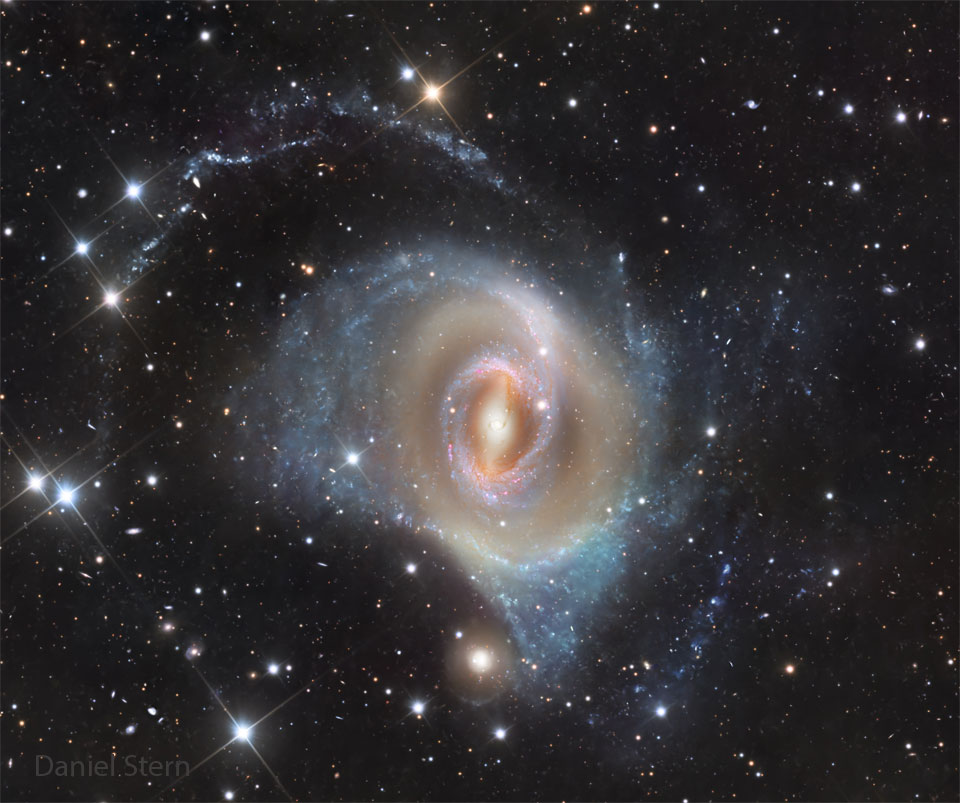
Spiral Galaxy NGC 1512: Wide Field
NASA APOD ·
Daniel Stern
Le texte de la NASA (anglais)
Most galaxies don't have any rings -- why does this galaxy have three? To begin, a ring that's near NGC 1512's center -- and so hard to see here -- is the nuclear ring which glows brightly with recently formed stars. Next out is a ring of stars and dust appearing both red and blue, called, counter-intuitively, the inner ring. This inner ring connects ends of a diffuse central bar of stars that runs horizontally across the galaxy. Farthest out in this wide field image is a ragged structure that might be considered an outer ring. This outer ring appears spiral-like and is dotted with clusters of bright blue stars. All these ring structures are thought to be affected by NGC 1512's own gravitational asymmetries in a drawn-out process called secular evolution. The featured image was captured last month from a telescope at Deep Sky Chile in Chile.
Lire sur apod.nasa.gov