Données astronomiques
Lever
08:11
Midi solaire13:04
Coucher
17:57
Gibbeuse décroissante
78 % éclairée
Durée du jour
9h 46min +3min 9s
Crépuscule civil
07:39 - 18:29
Heure dorée
16:57 - 17:57
Ciel à observer
Prochain rendez-vous céleste : Maximum des Lyrides, le 22 avril (jusqu'à 18 météores par heure), dans 75 jours
Image astronomique du jour
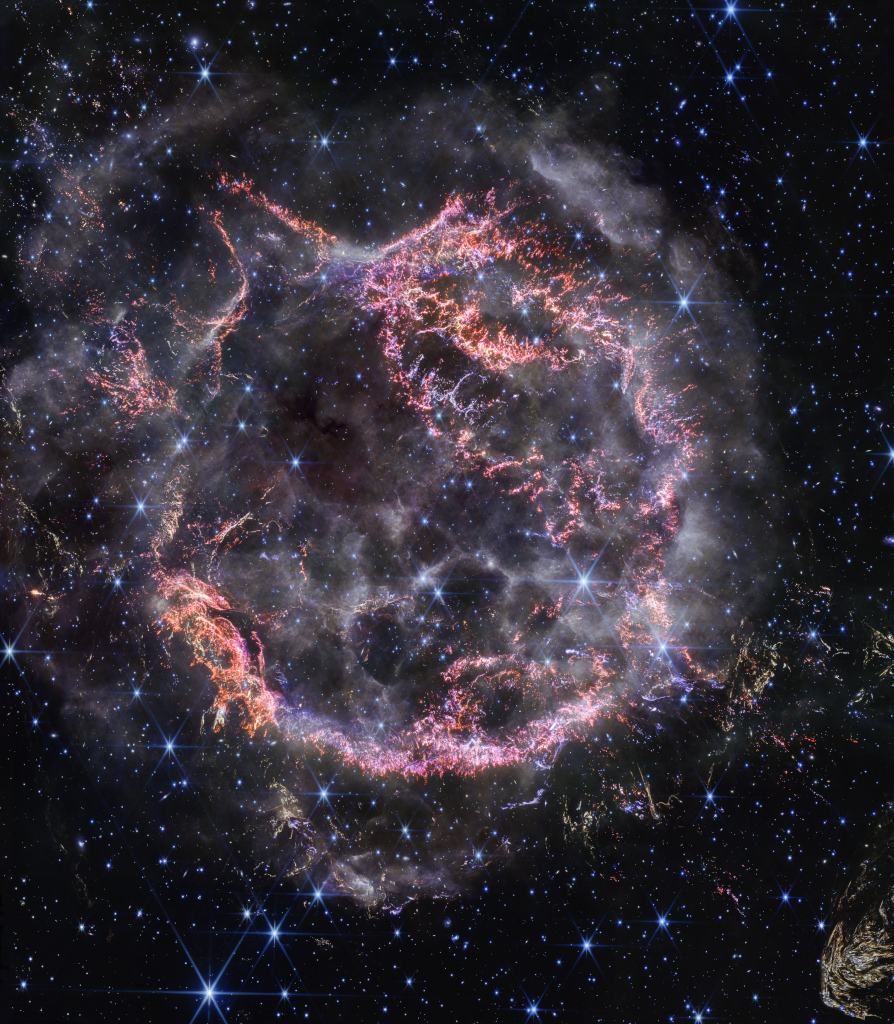
Supernova Remnant Cassiopeia A
NASA APOD
Le texte de la NASA (anglais)
Massive stars in our Milky Way Galaxy live spectacular lives. Collapsing from vast cosmic clouds, their nuclear furnaces ignite and create heavy elements in their cores. After only a few million years for the most massive stars, the enriched material is blasted back into interstellar space where star formation can begin anew. The expanding debris cloud known as Cassiopeia A is an example of this final phase of the stellar life cycle. Light from the supernova explosion that created this remnant would have been first seen in planet Earth's sky about 350 years ago, although it took that light 11,000 years to reach us. This sharp NIRCam image from the James Webb Space Telescope shows the still-hot filaments and knots in the supernova remnant. The whitish, smoke-like outer shell of the expanding blast wave is about 20 light-years across. A series of light echoes from the massive star's cataclysmic explosion are also identified in Webb's detailed images of the surrounding interstellar medium.
Lire sur apod.nasa.gov