Données astronomiques
Lever
08:03
Midi solaire13:04
Coucher
18:06
Dernier croissant
32 % éclairée
Durée du jour
10h 2min +3min 17s
Crépuscule civil
07:32 - 18:37
Heure dorée
17:06 - 18:06
Ciel à observer
Prochain rendez-vous céleste : Maximum des Lyrides, le 22 avril (jusqu'à 18 météores par heure), dans 70 jours
Image astronomique du jour
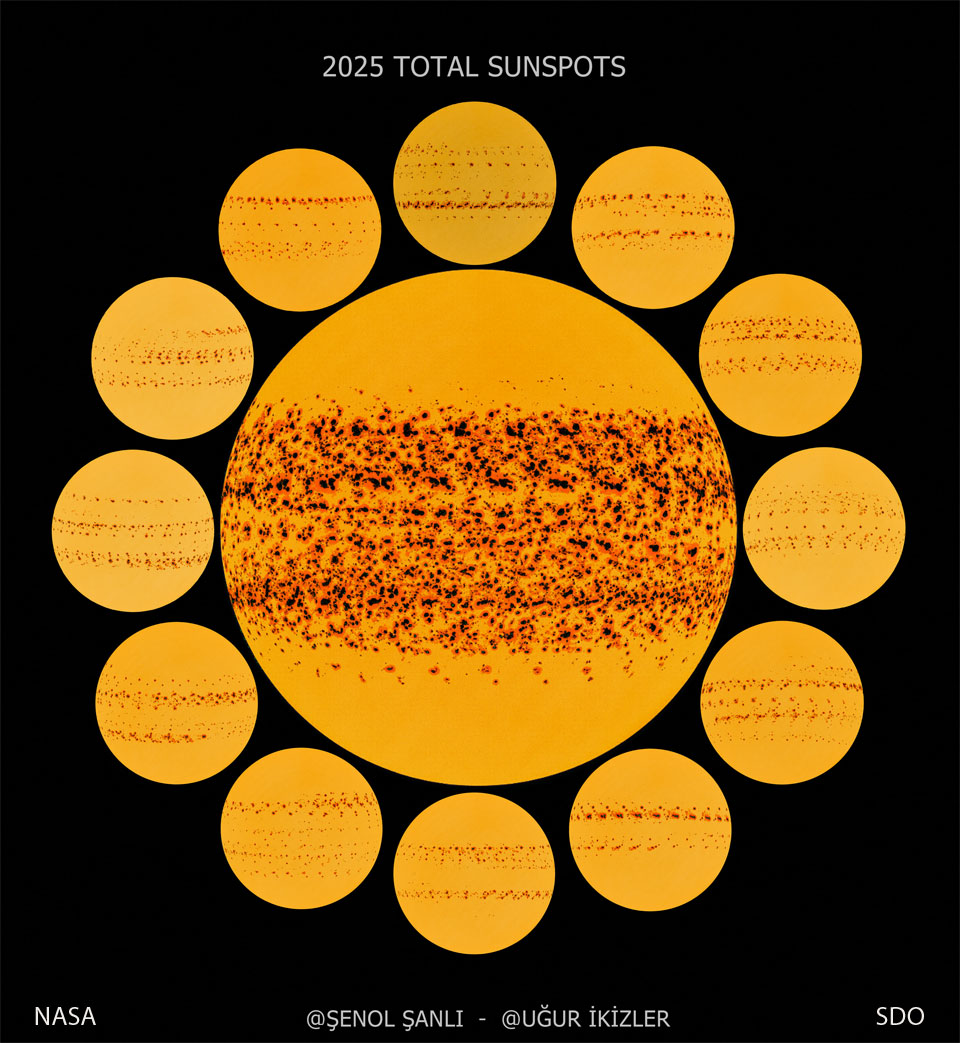
A Year of Sunspots
NASA APOD
Le texte de la NASA (anglais)
How many sunspots can you see? The central image shows the many sunspots that occurred in 2025, month by month around the circle, and all together in the grand central image. Each sunspot is magnetically cooled and so appears dark -- and can last from days to months. Although the featured images originated from NASA's Solar Dynamics Observatory, sunspots can be easily seen with a small telescope or binoculars equipped with a solar filter. Very large sunspot groups like recent AR 4366 can even be seen with eclipse glasses. Sunspots are still counted by eye, but the total number is not considered exact because they frequently change and break up. Last year, 2025, coincided with a solar maximum, the period of most intense magnetic activity during its 11-year solar cycle. Our Sun remains unpredictable in many ways, including when it ejects solar flares that will impact the Earth, and how active the next solar cycle will be.
Lire sur apod.nasa.gov