Données astronomiques
Lever
07:49
Midi solaire13:04
Coucher
18:19
Premier croissant
4 % éclairée
Durée du jour
10h 29min +3min 26s
Crépuscule civil
07:19 - 18:49
Heure dorée
17:19 - 18:19
Ciel à observer
Prochain rendez-vous céleste : Maximum des Lyrides, le 22 avril (jusqu'à 18 météores par heure), dans 62 jours
Image astronomique du jour
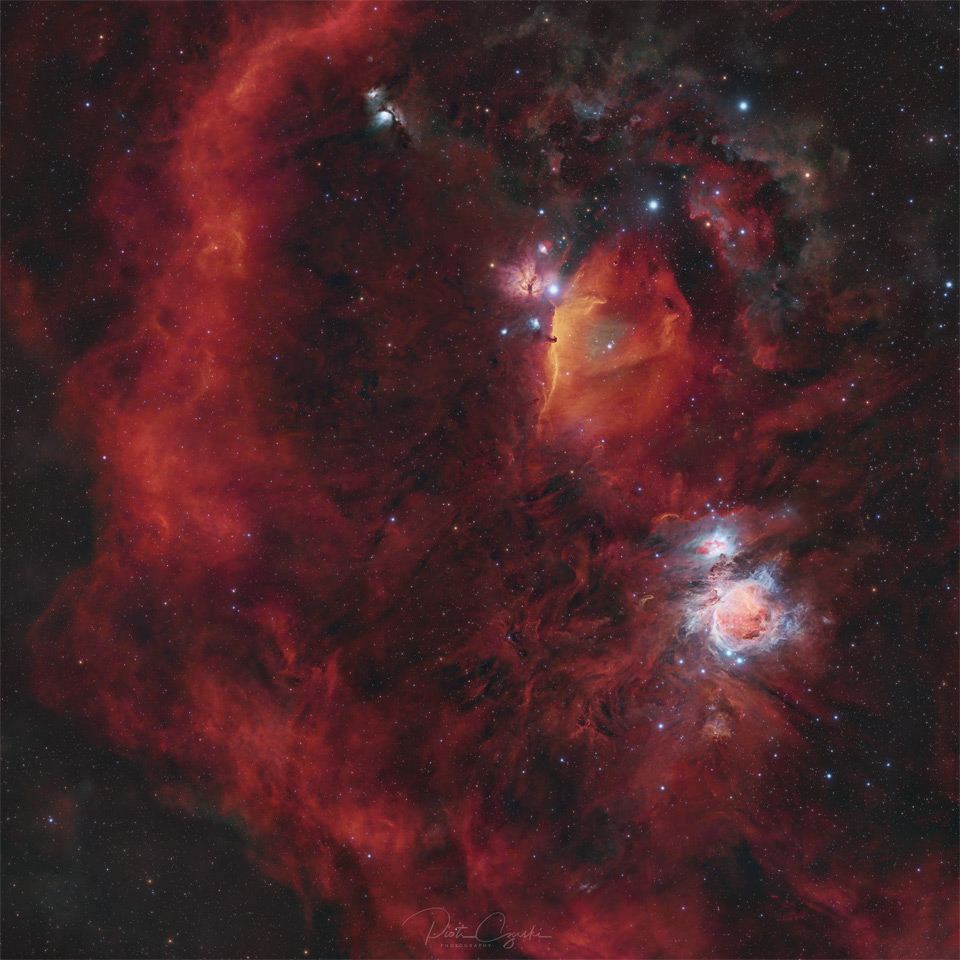
Orion's Cradle
NASA APOD · Piotr Czerski
Le texte de la NASA (anglais)
Cradled in red-glowing hydrogen gas, stars are being born in Orion. These stellar nurseries lie at the edge of the giant Orion molecular cloud complex, some 1,500 light-years away. This detailed view spans about 12 degrees across the center of the well-known constellation, with the Great Orion Nebula, the closest large star-forming region, visible toward the lower right. The deep mosaic also includes, near the top center, the Flame Nebula and the Horsehead Nebula. Image data acquired with a hydrogen-alpha filter adds other remarkable features to this wide-angle cosmic vista: pervasive tendrils of energized atomic hydrogen gas and portions of the surrounding Barnard's Loop. While the Orion Nebula and many stars in Orion are easy to see with the unaided eye, emission from the extensive interstellar gas is faint and much harder to record, even in telescopic views of the nebula-rich complex. Sky Surprise: What picture did APOD feature on your birthday? (after 1995)
Lire sur apod.nasa.gov