Données astronomiques
Lever
07:10
Midi solaire13:00
Coucher
18:50
Dernier quartier
50 % éclairée
Durée du jour
11h 40min +3min 36s
Crépuscule civil
06:40 - 19:20
Heure dorée
17:50 - 18:50
Ciel à observer
Prochain rendez-vous céleste : Maximum des Lyrides, le 22 avril (jusqu'à 18 météores par heure), dans 42 jours
Image astronomique du jour
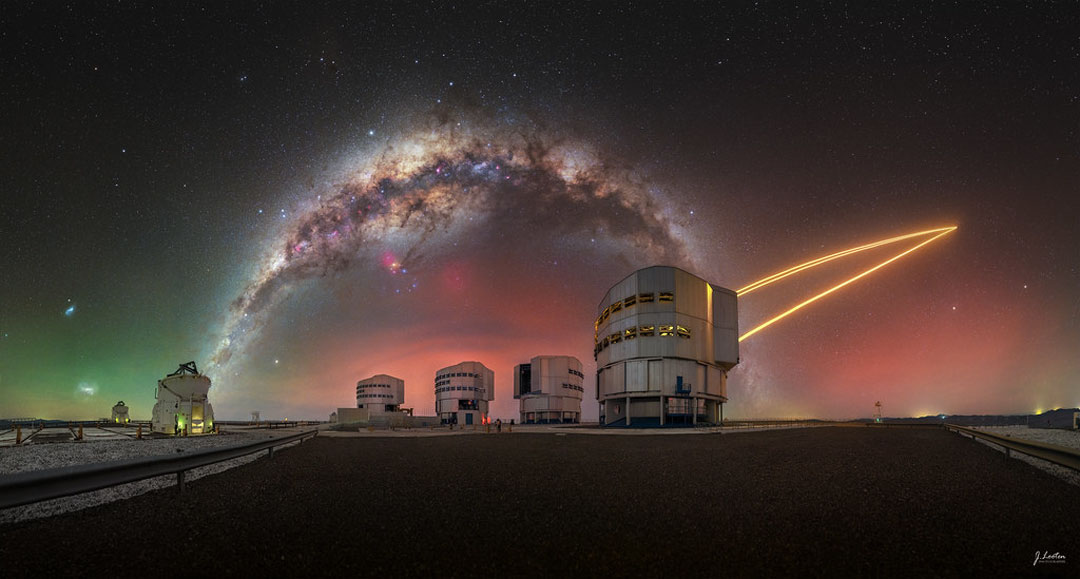
Sky Glows over Paranal Observatory
NASA APOD · Julien Looten
Le texte de la NASA (anglais)
Are lasers from giant telescopes being used to defend the Earth? No. Lasers shot from telescopes are now commonly used to help increase the accuracy of astronomical observations. In some directions, Earth atmosphere-induced fluctuations in starlight can indicate how the air mass over a telescope is changing, but in other directions, no bright star exists. In these directions, astronomers can create an artificial star with a laser. Subsequent observations of the artificial laser guide star can reveal information so detailed about the changing blurring effects of the Earth's atmosphere that much of it can be removed by rapidly flexing a telescope's mirror. Such adaptive optics techniques allow high-resolution ground-based observations of real stars, planets, and nebulas. Pictured here, telescopes at Paranal Observatory in Chile study a colorful sky filled with green airglow and the Magellanic Clouds on the left, red airglow on the right, and the majestic central band of our Milky Way Galaxy arching across the center.
Lire sur apod.nasa.gov