Données astronomiques
Lever
07:06
Midi solaire13:00
Coucher
18:53
Dernier croissant
31 % éclairée
Durée du jour
11h 47min +3min 37s
Crépuscule civil
06:36 - 19:23
Heure dorée
17:53 - 18:53
Ciel à observer
Prochain rendez-vous céleste : Maximum des Lyrides, le 22 avril (jusqu'à 18 météores par heure), dans 40 jours
Image astronomique du jour
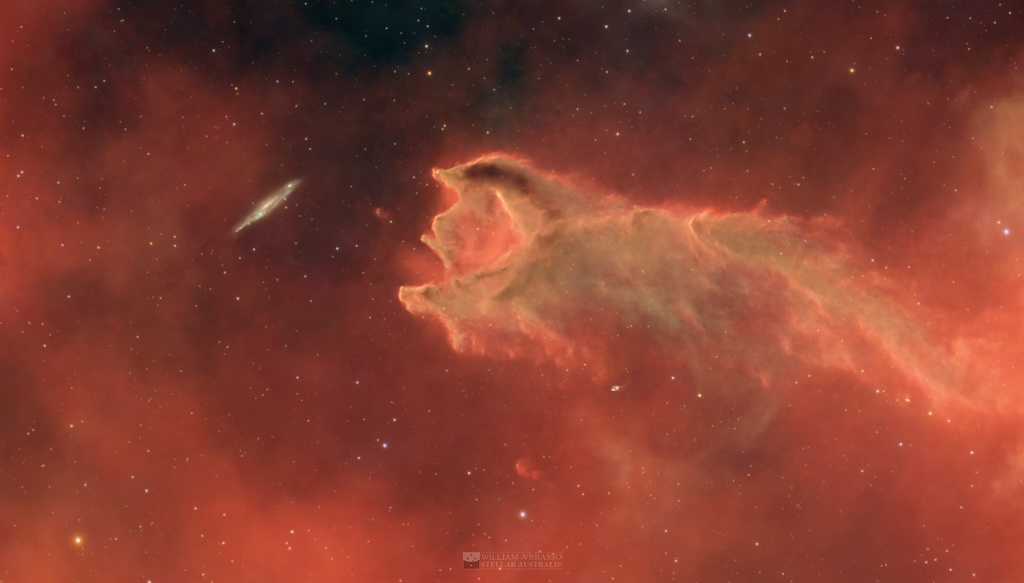
CG 4: The Globule and the Galaxy
NASA APOD · William Vrbasso
Le texte de la NASA (anglais)
Is this a cosmic monster ready to devour an unsuspecting galaxy? Thankfully, that is not the case. The red “monster” shown in the featured image is Cometary Globule CG 4, 1,300 light-years away in the Constellation Puppis. CG 4 is a molecular cloud, where hydrogen becomes cold enough to form molecules that can be brought together by gravity to create stars. The shape of CG 4 resembles that of a comet, but its head is 1.5 light-year in diameter and its tail is 8 light-years long; for comparison, the distance from the Earth to the sun is only 8 light-minutes. Astronomers believe that the tail of a cometary globule could have been shaped by a nearby supernova explosion or by irradiation from hot, massive stars. Indeed, CG 4 and other nearby globules point away from the Vela Supernova Remnant, at the center of the Gum Nebula. The edge-on spiral galaxy, ESO 257-19, is more than a hundred million light-years beyond CG 4, and is completely safe from the “monster”.
Lire sur apod.nasa.gov