Données astronomiques
Lever
07:26
Midi solaire13:54
Coucher
20:22
Pleine lune
100 % éclairée
Durée du jour
12h 56min +3min 36s
Crépuscule civil
06:55 - 20:52
Heure dorée
19:22 - 20:22
Ciel à observer
Prochain rendez-vous céleste : Maximum des Lyrides, le 22 avril (jusqu'à 18 météores par heure), dans 21 jours
Image astronomique du jour
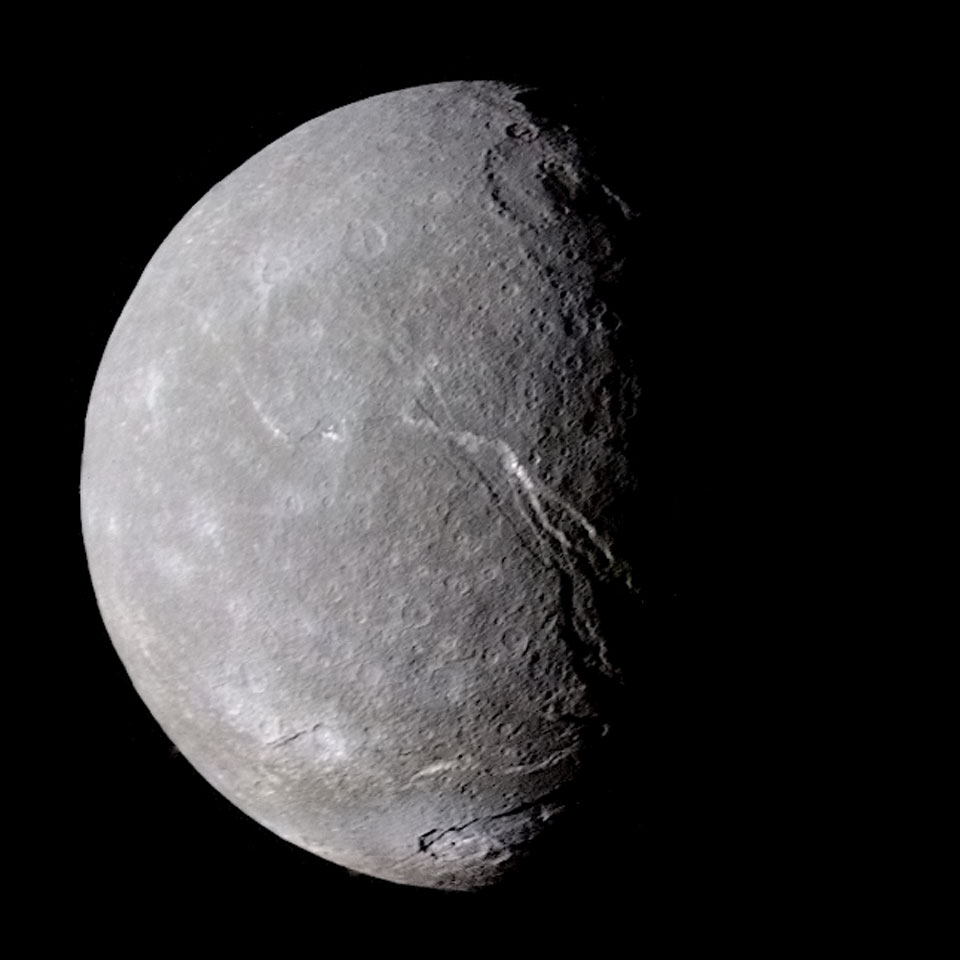
Uranus's Largest Moon: Titania
NASA APOD
Le texte de la NASA (anglais)
Titania's tortured terrain is a mix of canyons, cliffs, and craters. NASA's interplanetary robot spacecraft Voyager 2 passed the largest moon of Uranus in 1986 and took the feature picture. That the trenches of Titania resemble those on another moon of Uranus, Ariel, indicate that Titania underwent some violent surface event possibly related to water freezing and expanding in its distant past. Although Titania is Uranus's largest moon, it is only about half the radius of Triton - the largest moon of Uranus's sister planet Neptune, which itself is slightly smaller than Earth's Moon. Titania, discovered by William Herschel in 1787, is essentially a large dirty iceball that is composed of about half water-ice and half rock. There is recent speculation that radioactive heating melts some underground ice into oceans.
Lire sur apod.nasa.gov