Données astronomiques
Lever
07:20
Midi solaire13:53
Coucher
20:27
Gibbeuse décroissante
95 % éclairée
Durée du jour
13h 7min +3min 33s
Crépuscule civil
06:49 - 20:57
Heure dorée
19:27 - 20:27
Ciel à observer
Prochain rendez-vous céleste : Maximum des Lyrides, le 22 avril (jusqu'à 18 météores par heure), dans 18 jours
Image astronomique du jour
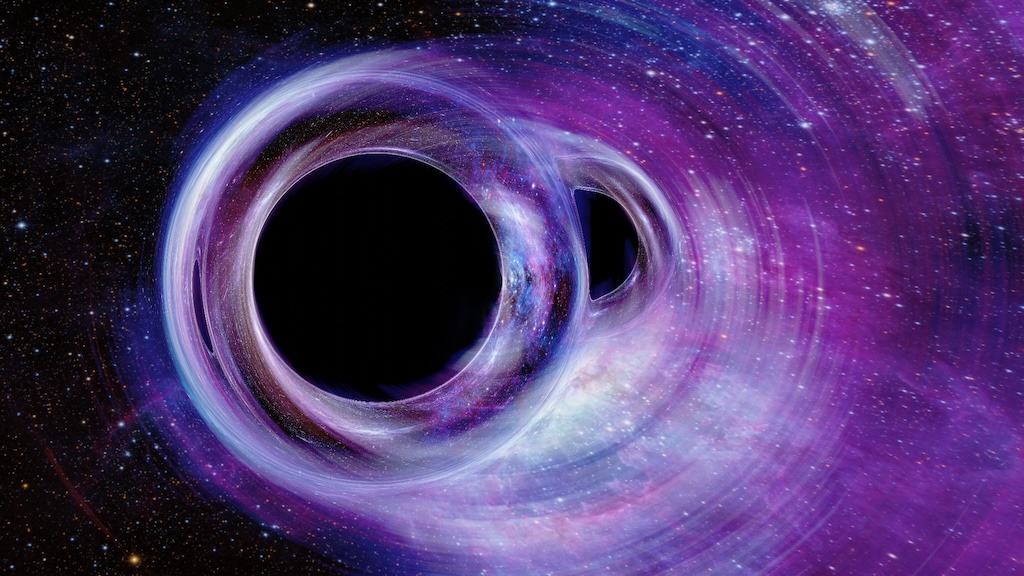
Caught in the Web: Visualization of a Black Hole Merger in the Tarantula Nebula
NASA APOD · Carl Knox
Le texte de la NASA (anglais)
How can we see what is invisible? Black holes are not easy to see in the dark cosmic night, but astronomers can find them by analyzing their gravitational effects on matter, light and spacetime. The featured image shows an illustration that combines a simulation of a black hole binary system in its final "death-dance" with an astrophotography image of the Tarantula Nebula in the background. Even though black holes don't emit light, they distort the path of light rays, acting like a gravitational lens. As a result, the nebula appears extremely distorted, forming Einstein rings and multiple images. Tarantula Nebula lies in the Large Magellanic Cloud, a dwarf galaxy that is one of the satellite galaxies of the Milky Way, 160,000 light-years away. That is more than 1,000 times closer than any of the binary black hole mergers detected so far. We'll probably never detect a merger so close to home!
Lire sur apod.nasa.gov