La plus ancienne pluie d'étoiles filantes connue : les chroniques chinoises la mentionnent déjà en 687 avant notre ère.
Activité déclinante après le maximum de la nuit du 22 au 23 avril · jusqu'à 18 météores par heure · radiant dans la Lyre, regarder vers le nord-est · poussières de la comète C/1861 G1 (Thatcher).
En activité
Êta Aquarides
Poussières laissées par la comète de Halley, que la Terre traverse chaque printemps. Depuis la France, on l'observe bas sur l'horizon, dans la dernière heure avant l'aube.
Maximum attendu la nuit du 5 au 6 mai · jusqu'à 50 météores par heure · radiant dans le Verseau, regarder vers l'est, avant l'aube · poussières de la comète de Halley.
Prochain rendez-vous céleste : Maximum des Delta Aquarides, le 30 juillet
(jusqu'à 25 météores par heure)
— dans 91 jours
Image astronomique du jour
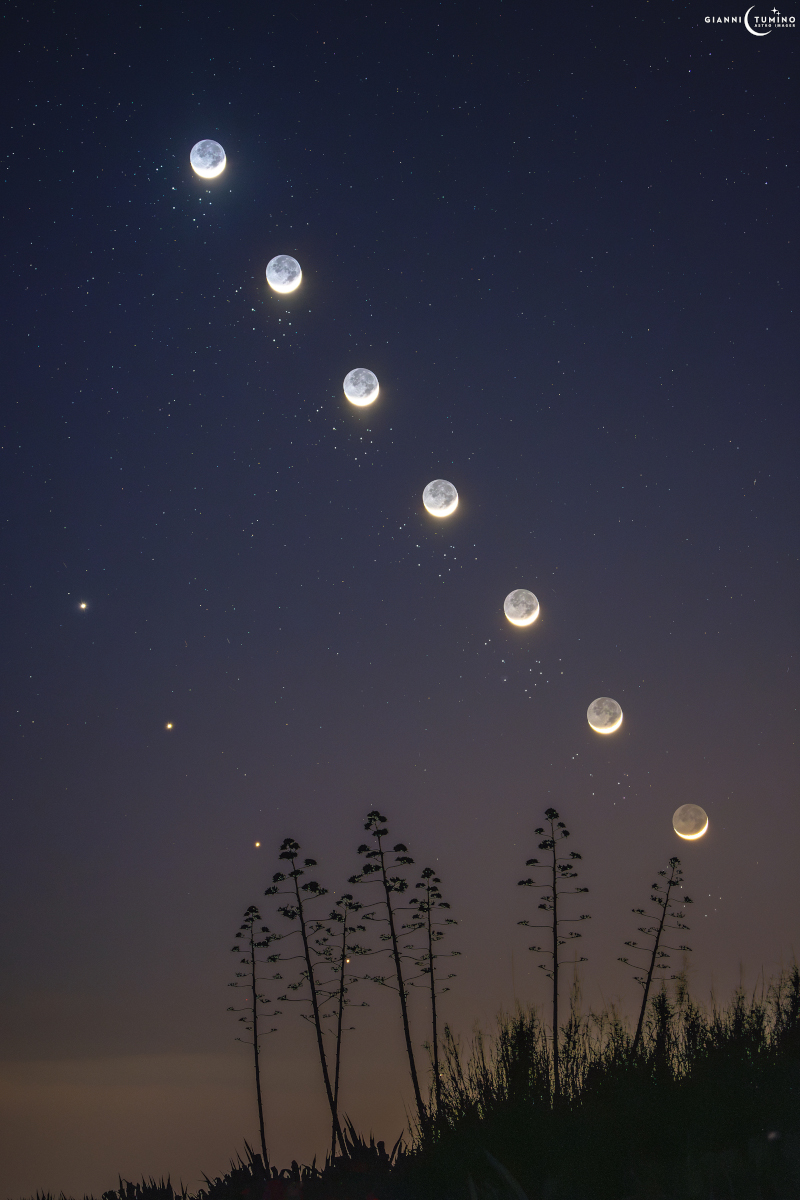
The Moon, Venus, and the Pleiades
No, Earth did not recently acquire six more moons! Today’s APOD is a combination of images following the Moon, Venus, and the Pleiades across a southern Sicilian sky as twilight turned to evening on April 19. From 2023 to 2029, the Pleiades' and the Moon “visit" each other once per month due to the Pleiades' location in the ecliptic plane. April 2026 saw the celestial alignment of their visit with Venus. About six stars in the Pleiades cluster (Messier 45) are typically visible with the unaided eye. Due to the cluster’s visibility across the world, there are many myths and legends across cultures associated with the Pleiades. The Haudenosaunee people of North America, for example, say that seven boys danced so enthusiastically that they lifted off into the sky. Astronomers recently found thousands more Pleiades members, showing that after thousands of years of gazing upon this cluster, there is yet more to learn about the Pleiades.