Éphéméride Chaque jour a son histoire

Éphéméride astronomique du jour

Données astronomiques

Lever 05:58
Midi solaire13:47
Coucher 21:36
Premier croissant, 22/05/2026
Premier croissant
39 % éclairée
Durée du jour 15h 37min +2min 19s
Crépuscule civil 05:20 - 22:13
Heure dorée 20:36 - 21:36

Ciel à observer

En activité

Êta Aquarides

Le contexte

Poussières laissées par la comète de Halley, que la Terre traverse chaque printemps. Depuis la France, on l'observe bas sur l'horizon, dans la dernière heure avant l'aube.

Activité déclinante après le maximum de la nuit du 5 au 6 mai · jusqu'à 50 météores par heure · radiant dans le Verseau, regarder vers l'est, avant l'aube · poussières de la comète de Halley.
Prochain rendez-vous céleste : Maximum des Delta Aquarides, le 30 juillet (jusqu'à 25 météores par heure), dans 69 jours

Image astronomique du jour

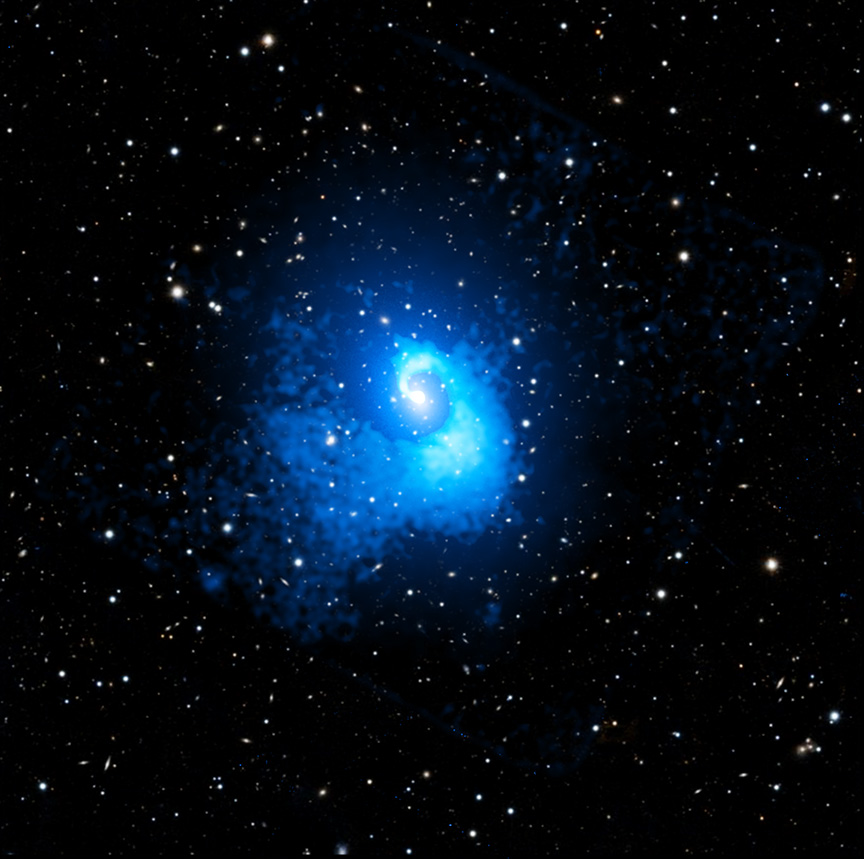
A Collision of Galaxy Clusters

A Collision of Galaxy Clusters

NASA APOD
Le texte de la NASA (anglais)

This big beautiful spiral shines in X-ray light. It is about 20 times larger than our Galaxy. It belongs to Abell 2029, a galaxy cluster one billion light-years away. (To see only the galaxies, hover your cursor over the image, or follow this link.) Galaxy clusters are the largest structures in the universe that are supported by gravity. Abell 2029 is formed by thousands of galaxies, surrounded by a huge cloud of hot gas and the equivalent of hundreds of trillions times the mass of the Sun in dark matter. The spiral is made of gas, mostly hydrogen and helium, heated to tens of millions of degrees. It was found in a recent study that used data from NASA's Chandra X-ray Observatory to show that Abell 2029 had a collision with a smaller cluster four billion years ago. The collision affected the gravitational field and caused the intracluster gas to slosh, like wine moving in a wine glass, shaping the spiral.

Lire sur apod.nasa.gov