Données astronomiques
Lever
05:45
Midi solaire13:49
Coucher
21:54
Dernier croissant
39 % éclairée
Durée du jour
16h 8min +1min 4s
Crépuscule civil
05:05 - 22:34
Heure dorée
20:54 - 21:54
Ciel à observer
Prochain rendez-vous céleste : Maximum des Delta Aquarides, le 30 juillet (jusqu'à 25 météores par heure), dans 51 jours
Image astronomique du jour
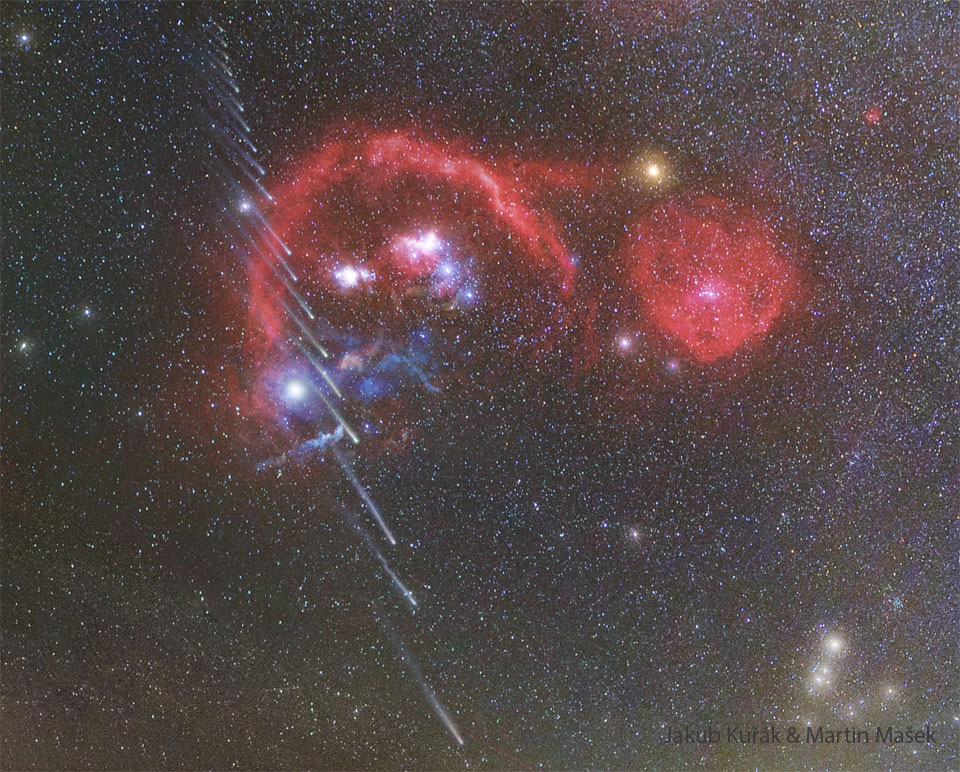
Comet R3 PanSTARRS Through Time
NASA APOD · Jakub Kuřák &
Martin Mašek
(FZU of the Czech Academy of Sciences)
Le texte de la NASA (anglais)
What happens to a comet as it leaves our inner Solar System? Now, the arrival of a comet into the inner Solar System is typically heralded with great fanfare and high hopes that the comet will become bright and photogenic. But on the way out, the comet's nucleus is less warmed by the Sun, less gas and dust are expelled, the bright coma around the nucleus shrinks and fades, and the tail length drops off. Many comets will then return to the outer Solar System and only return in hundreds or thousands of years. In contrast, some comets -- like Comet C/2025 R3 (PanSTARRS) -- receive a gravitational kick from the planets and so will never return. Pictured, Comet R3 PanSTARRs was imaged deeply many nights in early to mid-May near Cerro Paranal in Chile. Later images appear closer to the top and clearly show the shrinking ion tail. Comet R3 Gallery: Comet R3 PanSTARRS in 2026
Lire sur apod.nasa.gov