Données astronomiques
Lever
05:44
Midi solaire13:51
Coucher
21:59
Premier croissant
24 % éclairée
Durée du jour
16h 14min +12s
Crépuscule civil
05:04 - 22:39
Heure dorée
20:59 - 21:59
Ciel à observer
Prochain rendez-vous céleste : Maximum des Delta Aquarides, le 30 juillet (jusqu'à 25 météores par heure), dans 41 jours
Image astronomique du jour
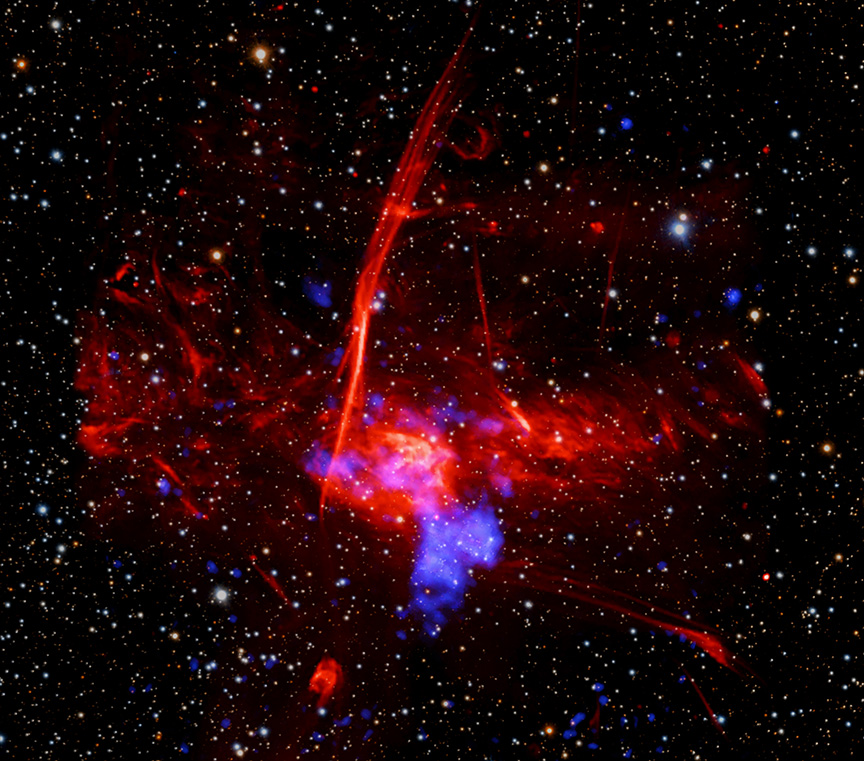
Possible Supernova Remnant in Galactic Center
NASA APOD · X-ray: NASA/CXC/UCLA/Z. Zhu et al.; ESA/XMM-Newton; Optical: PanSTARRS; Radio: MeerKAT; Image Processing: NASA/CXC/SAO/L. Frattare and P. Edmonds
Text:
Cecilia Chirenti
(NASA
GSFC,
UMCP,
CRESST II)
Le texte de la NASA (anglais)
Do you see that blue blob to the lower right of the image center? Astronomers think that it shows where a massive star exploded as a supernova whose light reached Earth 1,700 years ago. The image combines optical data from the PanSTARRS telescopes in Hawaii (background stars in red, green, and blue), radio from the MeerKAT telescope in South Africa (large red cloud) and X-rays from NASA's Chandra X-ray Observatory and ESA’s XMM-Newton (shown in blue). The large cloud is a star forming region called Sagittarius C, which is approximately 50 light-years in extent and about 26,000 light-years from Earth. It is located only about 260 light-years from the supermassive black hole in the center of the Galaxy (off to the left of the image). If the blue blob is confirmed to be a supernova remnant, it would be one of the closest ever discovered to the Galactic Center. In this dense region, the deaths of massive stars are connected to the birth of new stars through gas and magnetic fields in a complex way.
Lire sur apod.nasa.gov