Pluie d'été discrète mais régulière, aux météores lents. Elle se mêle aux premières Perséides à la fin juillet.
Maximum attendu la nuit du 29 au 30 juillet · jusqu'à 25 météores par heure · radiant dans le Verseau, regarder vers le sud · poussières de la comète 96P/Machholz.
Prochain rendez-vous céleste : Maximum des Perséides, le 12 août
(jusqu'à 100 météores par heure)
— dans 27 jours
Image astronomique du jour
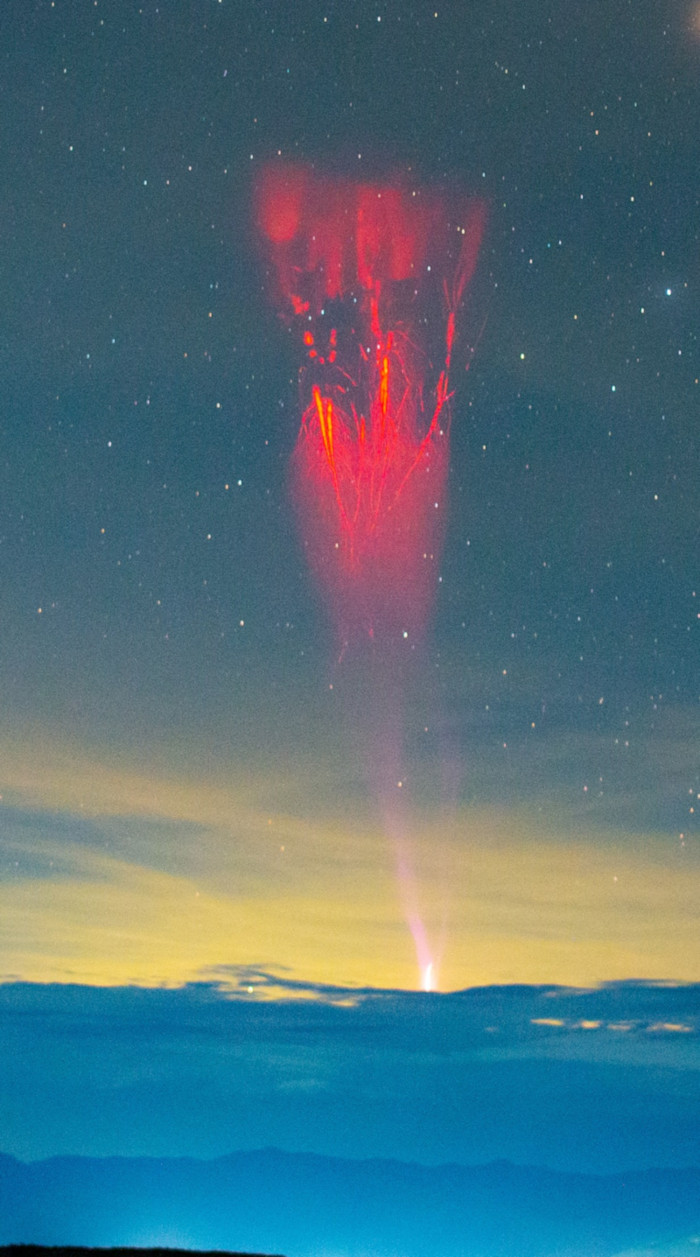
Red Sprites in the Tatacoa Desert
Is there an angry Sith using force lightning in the Tatacoa Desert? This is not science fiction, but a red sprite with multiple streamers! Ordinary lightning occurs when thundercloud particles collide, lose their electrons, and build up negative charge at the cloud bottom. The cloud’s negative charge repels negative charge deeper into the Earth, leaving Earth’s surface positively charged. The opposite charges attract, reaching towards each other and superheating the air into a white strike of plasma. Red sprites are millisecond events triggered by positive cloud-to-ground lightning. They extend up into the mesosphere where the air is too thin for thunder. Their red glow comes from heated molecular nitrogen. There are several potential causes for red sprites, including that the preceding positive lightning exposes the negatively charged cloud core to the positively charged upper atmosphere, allowing those charges to connect. NASA’s Juno has observed sprites on Jupiter, indicating that sprites occur on other planets!