Pluie d'été discrète mais régulière, aux météores lents. Elle se mêle aux premières Perséides à la fin juillet.
Maximum attendu la nuit du 29 au 30 juillet · jusqu'à 25 météores par heure · radiant dans le Verseau, regarder vers le sud · poussières de la comète 96P/Machholz.
En activité
Perséides
Les célèbres « larmes de saint Laurent », la pluie d'étoiles filantes la plus observée de l'année, idéale par les chaudes nuits d'août.
Maximum attendu la nuit du 12 au 13 août · jusqu'à 100 météores par heure · radiant dans Persée, regarder vers le nord-est · poussières de la comète 109P/Swift-Tuttle.
Prochain rendez-vous céleste : Éclipse totale de Soleil, le 12 août
— dans 14 jours
Image astronomique du jour
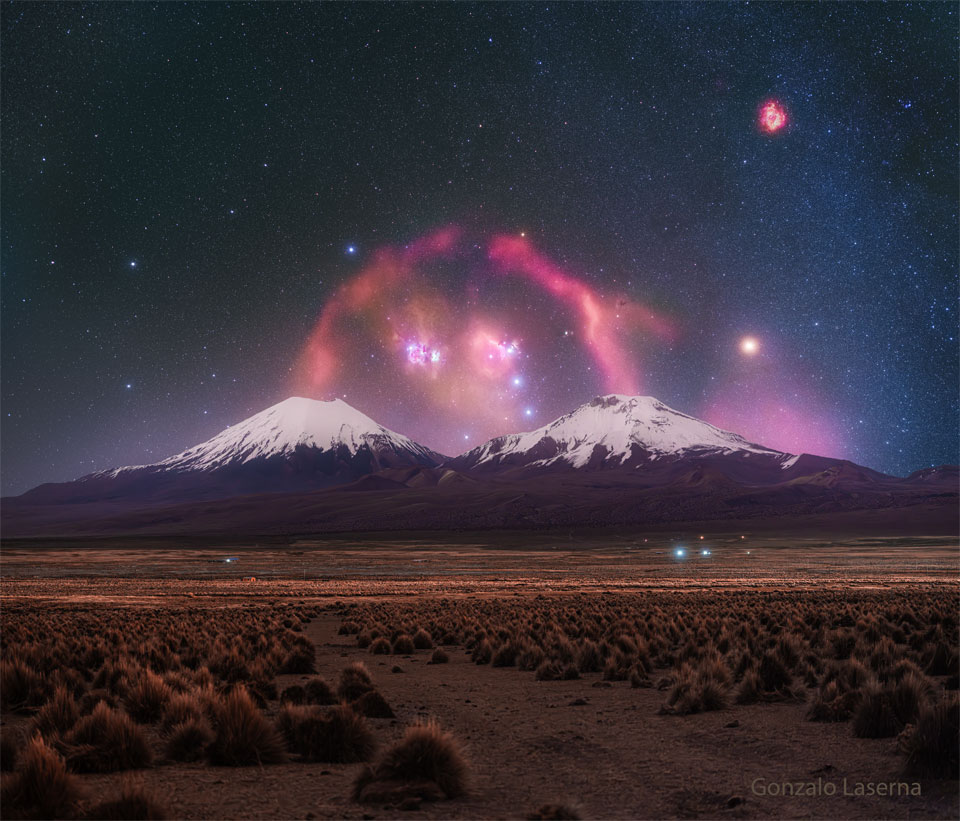
Barnards Loop over Twin Volcanoes
What's connecting these two volcanoes? In ancient folklore, the two volcanoes, Parinacota (left) and Pomerape (right), are connected by representing a mythical prince and princess who engaged in a forbidden romance. Beneath the ground, the two peaks are not known to be connected by a common pool of hot magma, and neither volcano has erupted in the past 1000 years. Above the ground, there is usually nothing in the sky that connects them -- except if you use careful timing and look from a specific location. The featured well-planned image was captured from Bolivia in mid-April with a series of camera exposures taken on the same day and from the same location. Then, Barnard's Loop appeared to connect the volcanic peaks. Also visible in the image is the Orion Nebula in the center, the star Betelgeuse on the right, and the Rosette Nebula on the upper right. Sky Surprise: What picture did APOD feature on your birthday? (after 1995)
Crédit : Gonzalo Laserna Vargas
Recevoir l'éphéméride chaque matin
Saints, astronomie, citations, histoire — directement dans votre boîte mail.