Données astronomiques
Lever
06:57
Midi solaire13:52
Coucher
20:47
Gibbeuse croissante
97 % éclairée
Durée du jour
13h 49min -3min 24s
Crépuscule civil
06:25 - 21:19
Heure dorée
19:47 - 20:47
Ciel à observer
Prochain rendez-vous céleste : Éclipse partielle de Lune, le 28 août, dans 2 jours
Image astronomique du jour
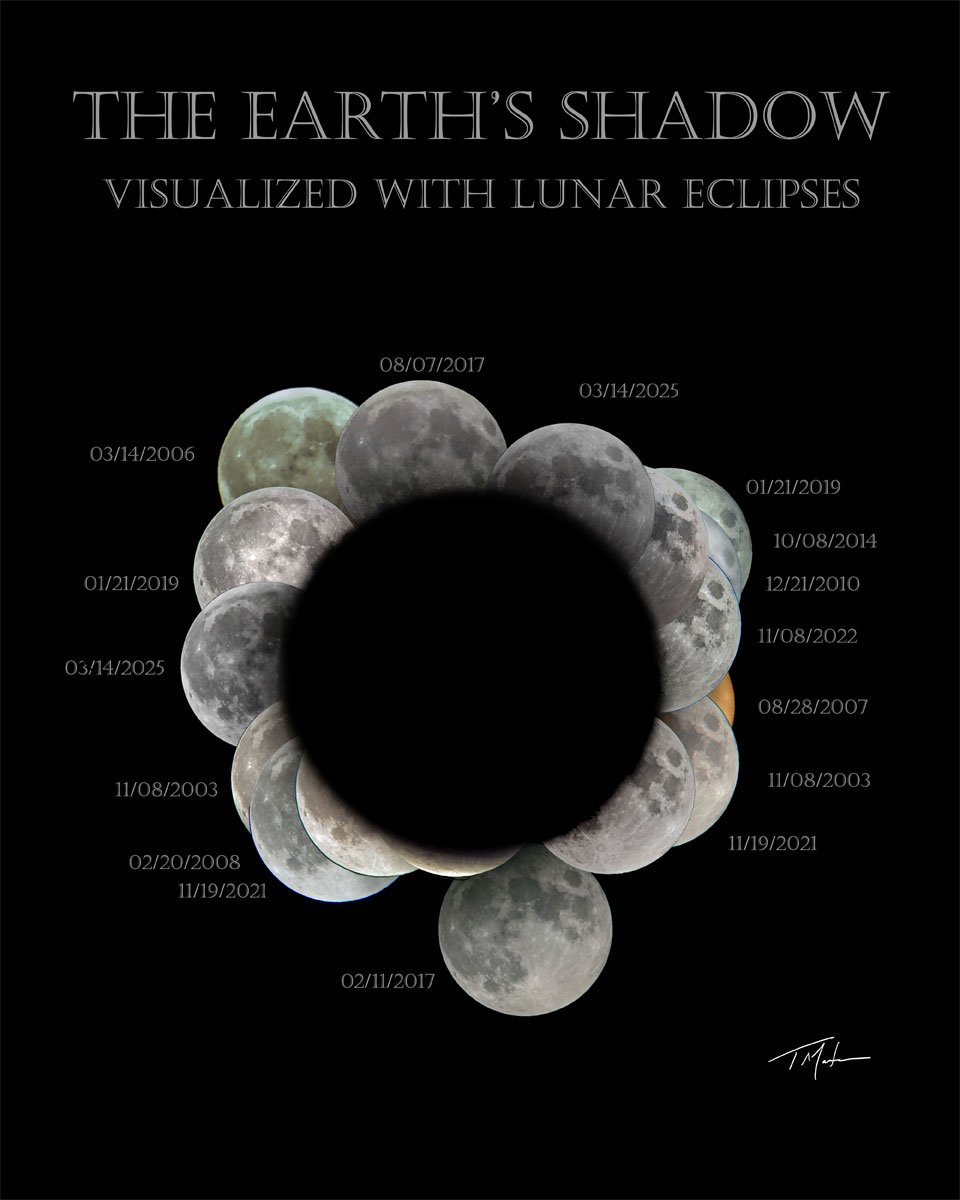
Earth's Shadow Visualized with Lunar Eclipses
NASA APOD · Tim Martin
Le texte de la NASA (anglais)
What’s creating this giant hole in space? This is not a black hole — it’s a shadow. It’s Earth’s shadow. Since at least the time of Aristotle, people have noted that Earth's dark shadow on the Moon during a partial lunar eclipse is circular -- although never a whole circle. Using modern digital technology, though, the images of multiple lunar eclipses can be combined to show Earth's complete shadow. The featured image compilation by a perseistent astrophotographer is constructed from 22 years of lunar eclipses. The Moon is not eclipsed every month (moon-th) because the Moon's orbit is slightly tilted relative to Earth's orbit. Close inspection of some lunar eclipse images shows a faint blue band where Earth’s atmosphere filters out more red sunlight than blue. Later this week, a new lunar eclipse will occur and will be best visible in parts of North and South America, Europe, and Africa. APOD's main NASA site is moving : From apod.nasa.gov to science.nasa.gov/apod
Lire sur apod.nasa.gov