Données astronomiques
Lever
07:35
Midi solaire13:43
Coucher
19:50
Gibbeuse croissante
81 % éclairée
Durée du jour
12h 15min -3min 34s
Crépuscule civil
07:05 - 20:20
Heure dorée
18:50 - 19:50
Ciel à observer
Prochain rendez-vous céleste : Maximum des Orionides, le 21 octobre (jusqu'à 20 météores par heure), dans 29 jours
Image astronomique du jour
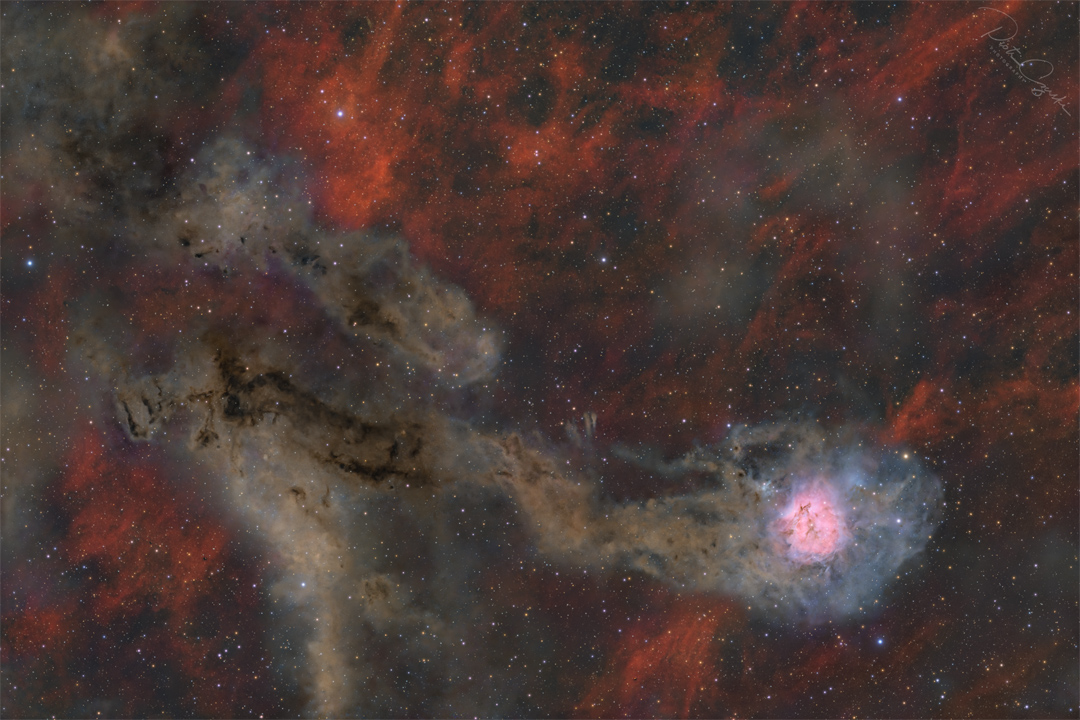
Cocoon Nebula Wide Field
NASA APOD · Piotr Czerski
Le texte de la NASA (anglais)
When does a nebula look like a comet? In this crowded starfield covering over two degrees within the high-flying constellation of the Swan (Cygnus), the eye is drawn to the Cocoon Nebula. A compact star forming region, the cosmic Cocoon punctuates a nebula bright in emission and reflection on the lower right, with a long trail of interstellar dust clouds to the left, making the entire complex appear a bit like a comet. Cataloged as IC 5146, the central bright head of the nebula spans about 10 light years, while the dark dusty tail spans nearly 100 light years. Both are located about 2,500 light years away. A bright star near the colorful nebula's center likely supplies power and helps clear out a cavity. The long dusty filaments of the tail, although dark in this visible light image, hide stars in the process of formation. The featured image was captured in July from Death Valley, California, USA. APOD's main NASA site is moving: From apod.nasa.gov to science.nasa.gov/apod
Lire sur apod.nasa.gov