✦ Éphéméride Chaque jour a son histoire

Éphéméride astronomique du jour

Données astronomiques

Lever 07:57
Midi solaire13:38
Coucher 19:19
Dernier croissant, 07/10/2026
Dernier croissant
12 % éclairée
Durée du jour 11h 21min -3min 32s
Crépuscule civil 07:27 - 19:49
Heure dorée 18:19 - 19:19

Ciel à observer

En activité

Orionides

Le contexte

Second passage annuel de la Terre dans le sillage de la comète de Halley : des météores rapides, jaillissant près de Bételgeuse.

Maximum attendu la nuit du 21 au 22 octobre · jusqu'à 20 météores par heure · radiant dans Orion, regarder vers le sud-est, après minuit · poussières de la comète de Halley.
Prochain rendez-vous céleste : Maximum des Léonides, le 17 novembre (jusqu'à 15 météores par heure), dans 41 jours

Image astronomique du jour

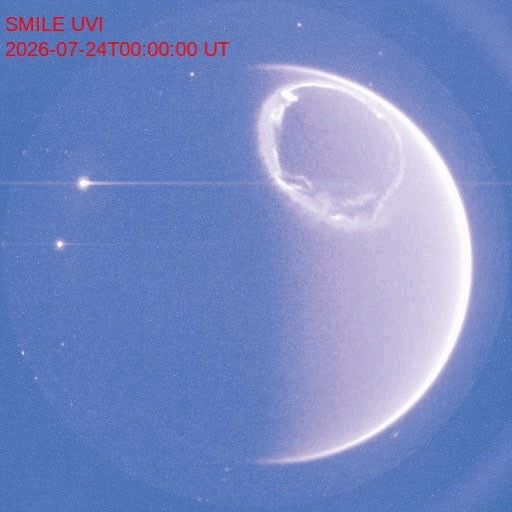
A Complete Auroral Oval from SMILE

A Complete Auroral Oval from SMILE

NASA APOD · ESA, CAS, SMILE, UVI
Le texte de la NASA (anglais)

Have you ever seen a complete auroral oval? You can't see one from the ground because it makes too large a circle around one of Earth's magnetic poles. But spacecraft high above the Earth can see them. The featured video from ESA and CAS's robotic SMILE spacecraft shows not only a full auroral oval, but using ultraviolet light, one that occurred during the day. The time-lapse covers about an hour in late July and shows visually how variable and turbulent auroras really are. The points of light on the sides are distant stars that appear to move only because SMILE's camera view shifts as the spacecraft orbits the Earth. A goal of SMILE is to better understand how the Sun's wind interacts with the Earth's magnetosphere -- and so better understand how to protect astronauts, spacecraft, and ground-based electrical grids from solar storms.

Lire sur apod.nasa.gov