Données astronomiques
Lever
07:36
Midi solaire13:03
Coucher
18:30
Gibbeuse croissante
72 % éclairée
Durée du jour
10h 53min +3min 32s
Crépuscule civil
07:06 - 19:00
Heure dorée
17:30 - 18:30
Ciel à observer
Prochain rendez-vous céleste : Maximum des Lyrides, le 22 avril (jusqu'à 18 météores par heure), dans 55 jours
Image astronomique du jour
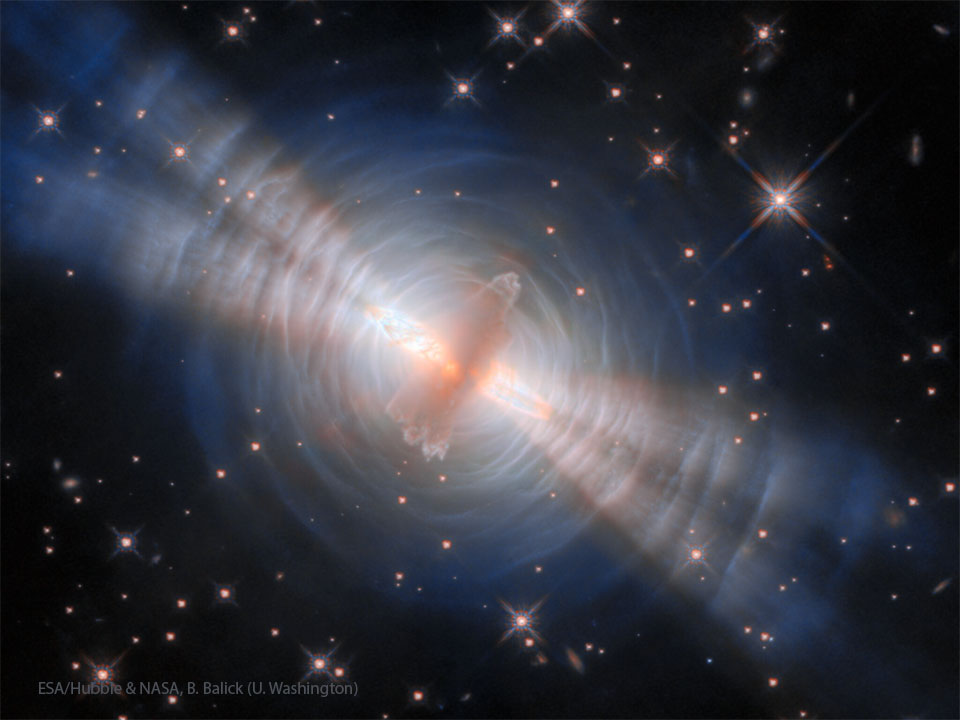
The Egg Nebula from the Hubble Telescope
NASA APOD · ESA/Hubble &
NASA,
B. Balick
(U. Washington)
Le texte de la NASA (anglais)
ver wonder what it would look like to crack open the Sun? The Egg Nebula, a dying Sun-like star, can unscramble this question. Pictured is a combination of several visible and infrared images of the nebula (also known as RAFGL 2688 or CRL 2688) taken with the Hubble Space Telescope. The star has shed its outer layers, and a bright, hot core (or "yolk") now illuminates the milky "egg white" shells of gas and dust surrounding the center. The central lobes and rings are structures of gas and dust recently ejected into space, with the dust being dense enough to block our view of the stellar core. Light beams emanate from that blocked core, escaping through holes carved in the older ejected material by newer, faster jets expelled from the star’s poles. Astronomers are still trying to figure out what causes the disks, lobes, and jets during this short (only a few thousand years!) phase of the star’s evolution, making this an egg-cellent image to study!
Lire sur apod.nasa.gov