Données astronomiques
Lever
07:18
Midi solaire13:01
Coucher
18:44
Gibbeuse décroissante
84 % éclairée
Durée du jour
11h 26min +3min 36s
Crépuscule civil
06:48 - 19:14
Heure dorée
17:44 - 18:44
Ciel à observer
Prochain rendez-vous céleste : Maximum des Lyrides, le 22 avril (jusqu'à 18 météores par heure), dans 46 jours
Image astronomique du jour
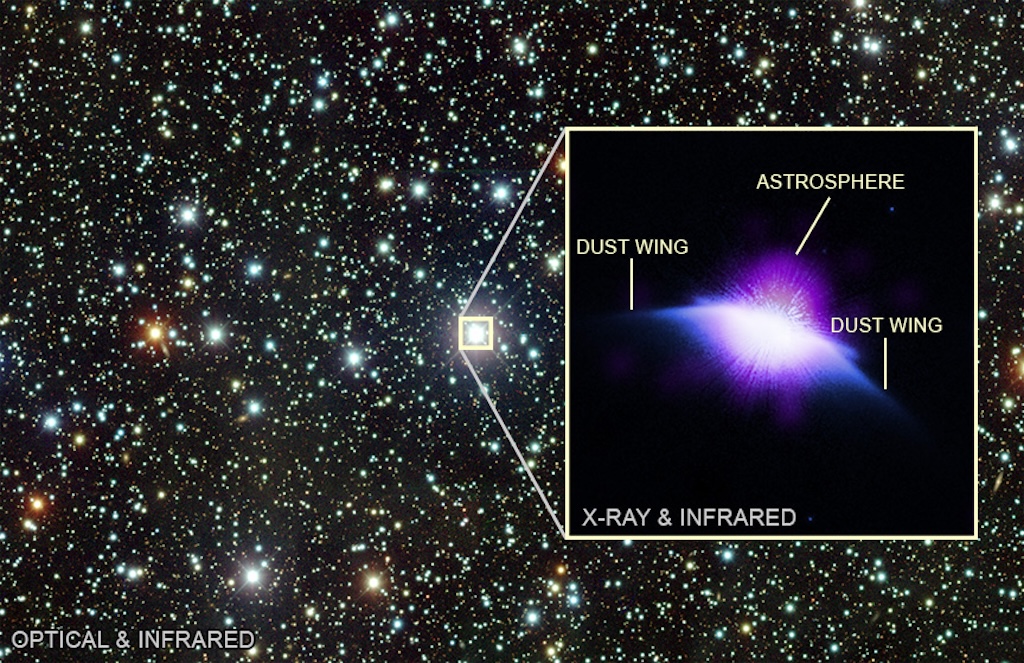
The Astrosphere of HD 61005
NASA APOD
Le texte de la NASA (anglais)
Do young stars blow bubbles? The larger view shows a stellar field observed with the Cerro Tololo Inter-American Observatory in Chile, and the inset highlights HD 61005, a star like our Sun, only 120 light-years away. Much younger than the Sun, at just about 100 million years old, it blows a fast and dense stellar wind that pushes out the cooler dust and gas that surrounds it, forming a bubble called an astrosphere. The star-blown bubble was detected with the Chandra X-ray Observatory, and it has a diameter roughly 200 times the Earth-Sun distance. Our Sun has a bubble too, called the heliosphere, which protects the planets from cosmic radiation. Also shown in the inset is debris left behind from star formation, observed by Hubble. The debris appears as wings, giving the star its nickname: the Moth.
Lire sur apod.nasa.gov