Données astronomiques
Lever
07:16
Midi solaire13:01
Coucher
18:46
Gibbeuse décroissante
77 % éclairée
Durée du jour
11h 29min +3min 35s
Crépuscule civil
06:46 - 19:15
Heure dorée
17:46 - 18:46
Ciel à observer
Prochain rendez-vous céleste : Maximum des Lyrides, le 22 avril (jusqu'à 18 météores par heure), dans 45 jours
Image astronomique du jour
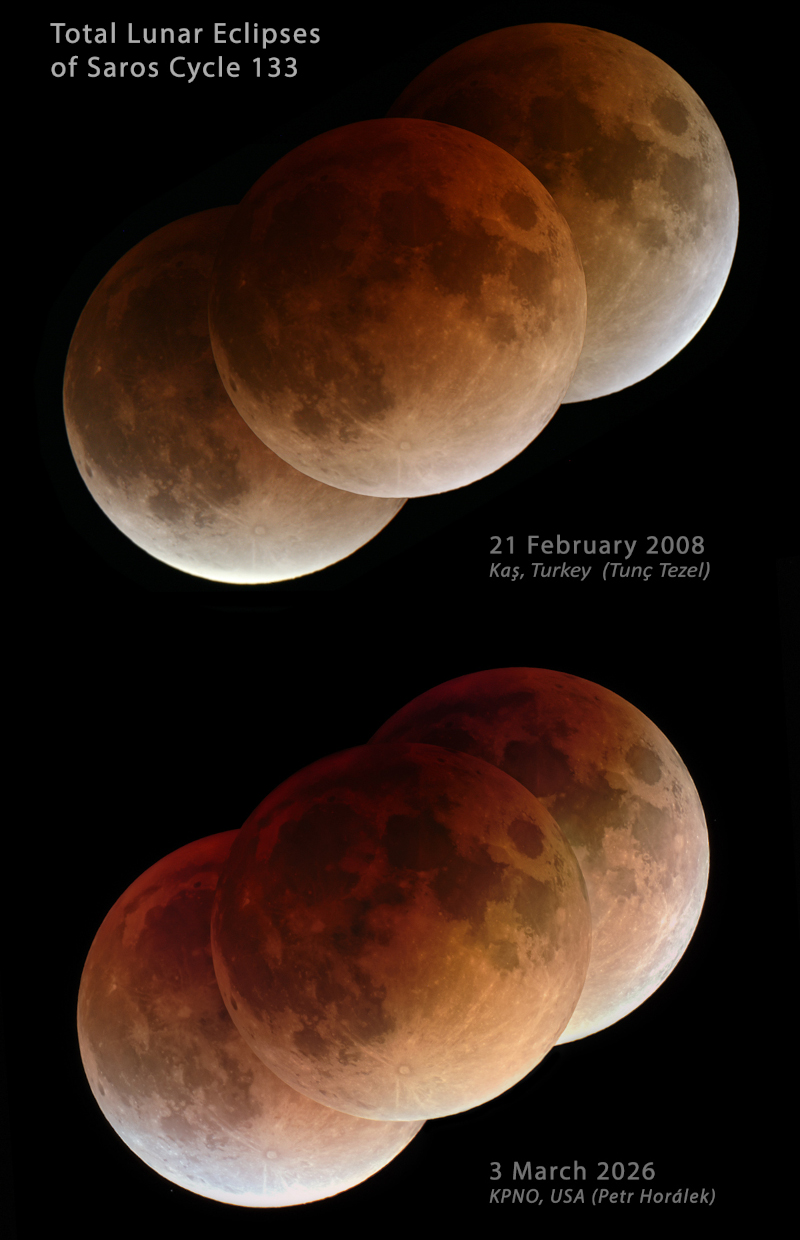
Two Eclipses of Saros 133
NASA APOD · Tunc Tezel
Le texte de la NASA (anglais)
Centered on maximum eclipse, these two total lunar eclipse sequences look almost identical. Yet the one shown on top is composed of images recorded in February 2008, while at the bottom is the recent March 2026 total eclipse of the Moon. Why are they so similar? Because these two total lunar eclipses are from the same Saros cycle. The Saros cycle was discovered historically from observations of the Moon's orbit. With a period of 18 years, 11 and 1/3 days, the cycle predicts when the Sun, Earth, and Moon all return to the same relative geometry for a lunar (or solar) eclipse. Eclipses separated by one Saros period belong to the same numbered Saros series, in this case Saros 133. So expect the next lunar eclipse in Saros 133 to be a repeat of this year's March 3 eclipse. You can watch the next Saros 133 total lunar eclipse on March 13, 2044. Growing Gallery: Total Lunar Eclipse of March 3
Lire sur apod.nasa.gov