Pluie d'été discrète mais régulière, aux météores lents. Elle se mêle aux premières Perséides à la fin juillet.
Maximum attendu la nuit du 29 au 30 juillet · jusqu'à 25 météores par heure · radiant dans le Verseau, regarder vers le sud · poussières de la comète 96P/Machholz.
En activité
Perséides
Les célèbres « larmes de saint Laurent », la pluie d'étoiles filantes la plus observée de l'année, idéale par les chaudes nuits d'août.
Maximum attendu la nuit du 12 au 13 août · jusqu'à 100 météores par heure · radiant dans Persée, regarder vers le nord-est · poussières de la comète 109P/Swift-Tuttle.
Prochain rendez-vous céleste : Éclipse totale de Soleil, le 12 août
— dans 19 jours
Image astronomique du jour
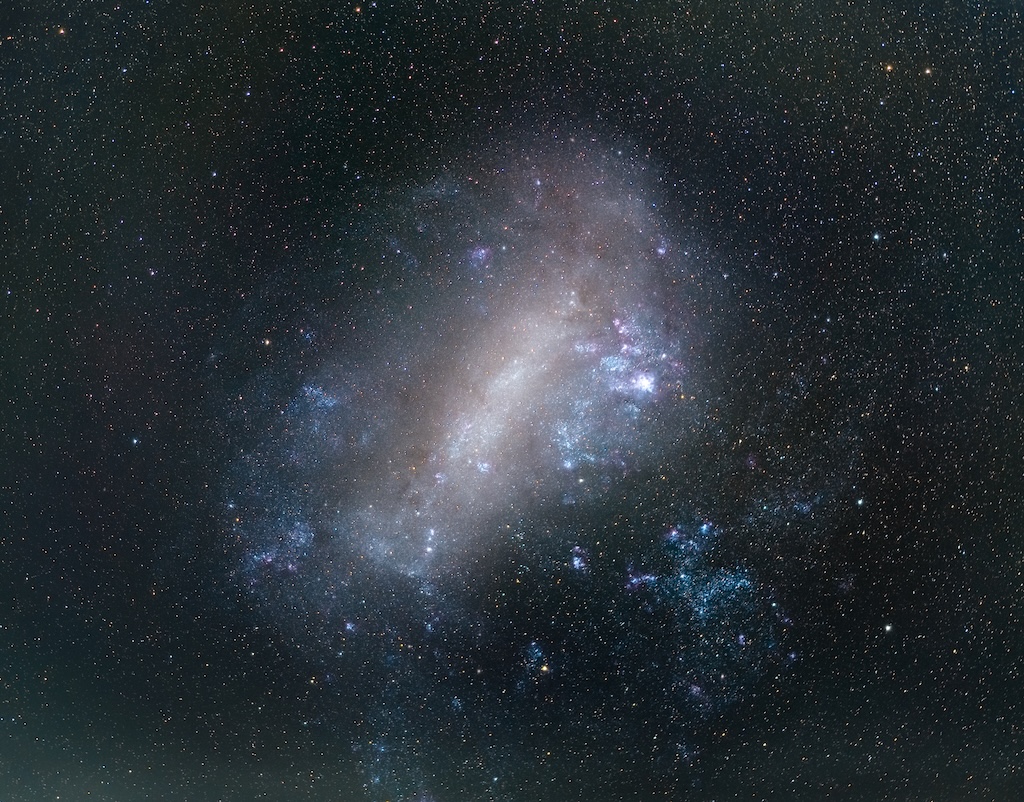
The Large Magellanic Cloud
Have you ever seen another galaxy with your own eyes? The featured image shows the Large Magellanic Cloud (LMC), one of the closest neighbors of our Milky Way. If you are anywhere south of latitude 20° N (but the further south, the better), you can see it with the unaided eye if you go to a dark sky location, away from big cities and light polution. It is a dwarf irregular galaxy about 163,000 light-years away, and a member of our Local Group of galaxies. Despite being small, with a total mass approximately equivalent to 10% - 20% of the mass of the Milky Way, the LMC is very actively forming stars. This is likely due in part to the gravitational push and pull of tides caused by the Milky Way on the LMC. Some astronomers have predicted that it will collide with the Milky Way in in about 2 billion years.