Éphéméride Chaque jour a son histoire

Éphéméride astronomique du jour

Données astronomiques

Soleil
Lever
06:38
Coucher
21:11
Durée du jour 14h 32min (-3min 10s) Midi solaire 13:55 Crépuscule civil 06:05 — 21:45 Heure dorée 20:11 — 21:11
Lune
Premier croissant — 13/08/2026
Premier croissant
Illumination : 1%

Ciel à observer

En activité

Delta Aquarides

Pluie d'été discrète mais régulière, aux météores lents. Elle se mêle aux premières Perséides à la fin juillet.

Activité déclinante après le maximum de la nuit du 29 au 30 juillet · jusqu'à 25 météores par heure · radiant dans le Verseau, regarder vers le sud · poussières de la comète 96P/Machholz.
En activité

Perséides

Les célèbres « larmes de saint Laurent », la pluie d'étoiles filantes la plus observée de l'année, idéale par les chaudes nuits d'août.

Activité déclinante après le maximum de la nuit du 12 au 13 août · jusqu'à 100 météores par heure · radiant dans Persée, regarder vers le nord-est · poussières de la comète 109P/Swift-Tuttle.

Prochain rendez-vous céleste : Éclipse partielle de Lune, le 28 août — dans 15 jours

Image astronomique du jour

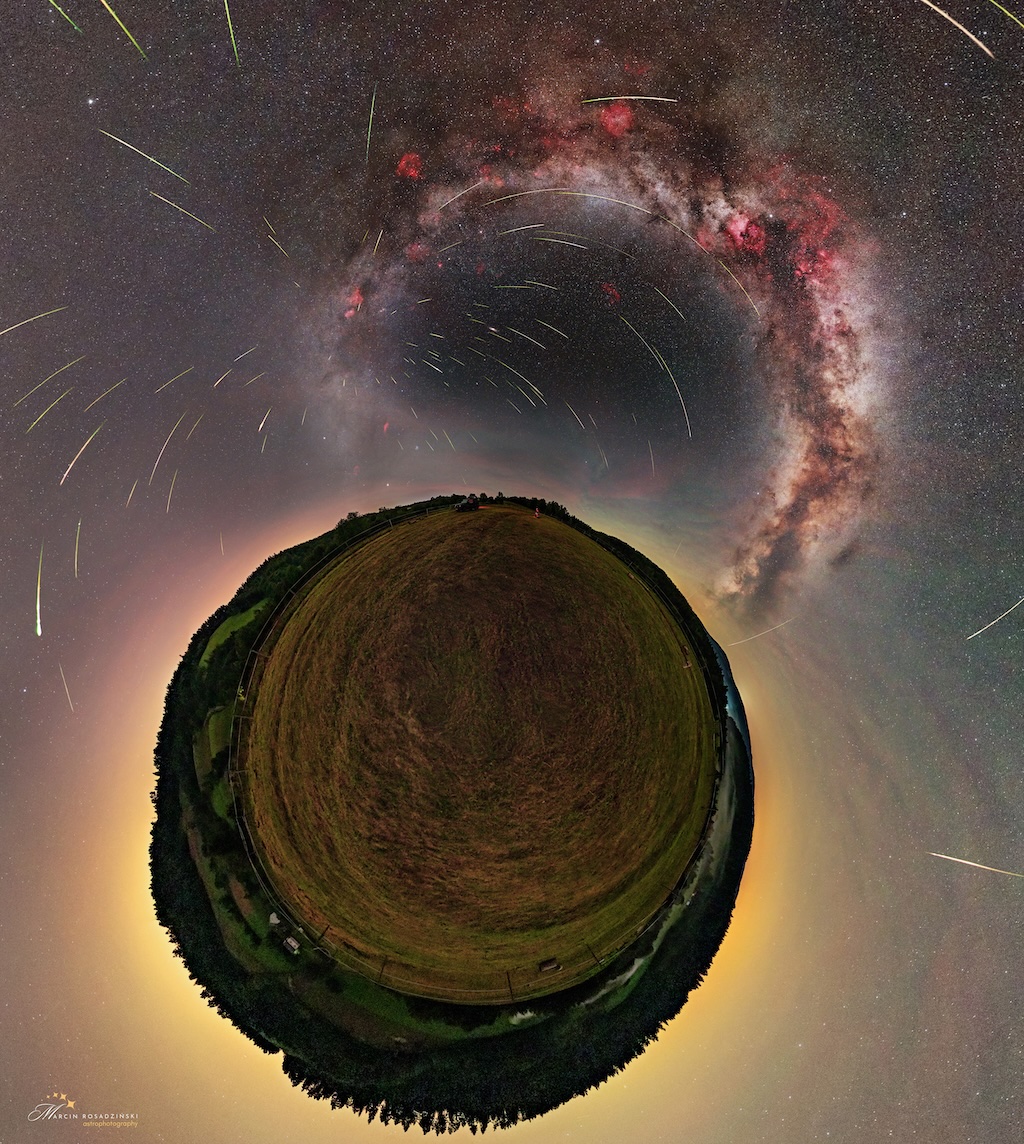
Perseids Over a little Planet

Perseids Over a little Planet

It looks like a view from the Little Prince's planet. The featured image is a throwback to the 2024 Perseid meteor shower, surrounded in this projection by the Bieszczady Mountains in Poland. Visible in the sky is the arch of the Milky Way, along with several nebulas in red and over a hundred meteors pointing to the radiant. The Perseids are easily visible and quite popular in the Northern Hemisphere summer. (Watching meteor showers in the winter is less convenient for a good reason). This year they are expected to offer an even more dazzling spectacle than usual, because the peak coincides with a new moon. The 2026 Perseid meteor shower will peak tonight with as many as 50-100 meteors per hour, when the Earth's path crosses through debris left behind by Comet Swift-Tuttle. Typically, the best times for seeing the meteors are between midnight and pre-dawn. You won't need binoculars to see the meteors, but a lawn chair and a dark sky location help. There is total solar eclipse happening today! See here if you are in the path of totality.

Crédit : Marcin Rosadziński Text: Cecilia Chirenti (NASA GSFC, UMCP, CRESST II)