Pluie d'été discrète mais régulière, aux météores lents. Elle se mêle aux premières Perséides à la fin juillet.
Activité déclinante après le maximum de la nuit du 29 au 30 juillet · jusqu'à 25 météores par heure · radiant dans le Verseau, regarder vers le sud · poussières de la comète 96P/Machholz.
En activité
Perséides
Les célèbres « larmes de saint Laurent », la pluie d'étoiles filantes la plus observée de l'année, idéale par les chaudes nuits d'août.
Activité déclinante après le maximum de la nuit du 12 au 13 août · jusqu'à 100 météores par heure · radiant dans Persée, regarder vers le nord-est · poussières de la comète 109P/Swift-Tuttle.
Prochain rendez-vous céleste : Éclipse partielle de Lune, le 28 août
— dans 14 jours
Image astronomique du jour
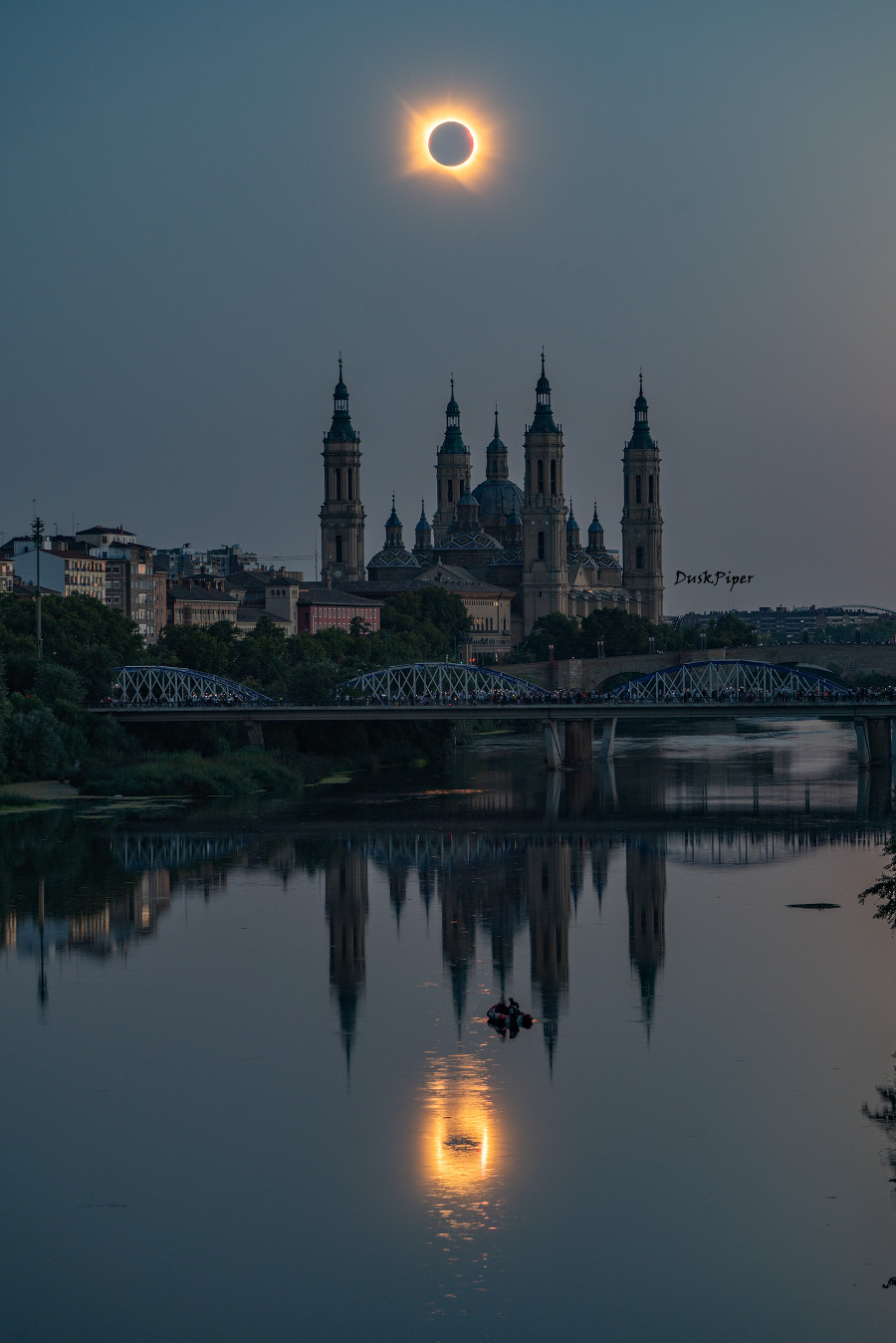
Total Solar Eclipse Over Spain
On August 12th, 2026, the Moon totally eclipsed the Sun and cast its shadow across Siberia, Greenland, Iceland, Spain, and Portugal. Today’s image features two total solar eclipses viewed from Zaragoza, Spain, one over the Cathedral-Basilica of Our Lady of the Pillar and the other reflecting in the Ebro River. For a few moments, Spain saw its first major total solar eclipse since 1905. Those witnessing totality may experience a chill in the air, the quieting of birds, the confused chirps of insects, and the shared awe of many. It’s the corona’s time to shine as the Sun’s bright disk is blocked by the Moon. Among other reasons to study eclipses, they help scientists understand why the corona is millions of degrees hotter than the Sun’s surface. Enthusiastic citizens can contribute to these studies by recording how wildlife responds, imaging the corona, and monitoring air temperature and clouds. More spectacular eclipse images: Solar Eclipse of 2026 August 12