Données astronomiques
Lever
07:17
Midi solaire13:47
Coucher
20:18
Dernier croissant
4 % éclairée
Durée du jour
13h 1min -3min 31s
Crépuscule civil
06:46 - 20:49
Heure dorée
19:18 - 20:18
Ciel à observer
Prochain rendez-vous céleste : Maximum des Orionides, le 21 octobre (jusqu'à 20 météores par heure), dans 42 jours
Image astronomique du jour
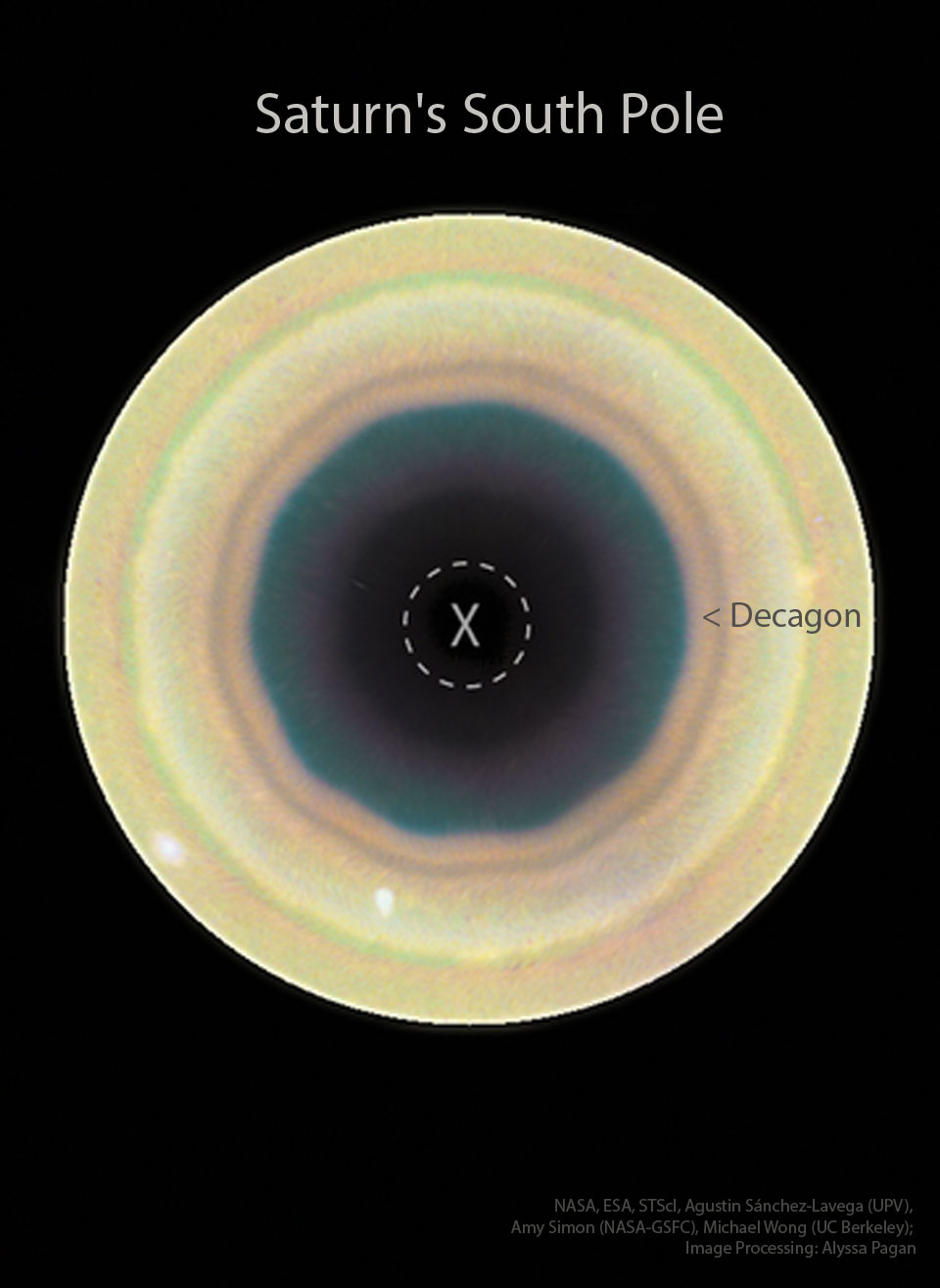
Hubble: Decagon Around Saturn's South Pole
NASA APOD
Le texte de la NASA (anglais)
Why are Saturn’s poles geometric? Saturn’s North Pole has been known to be surrounded by a hexagonal (6 sides) cloud since discovery in 1987 in data taken by NASA’s Voyager spacecrafts, which quickly flew past the ringed world in the early 1980s. Now, recent observations of Saturn by the Hubble Space Telescope reveal a slightly different geometric cloud pattern around the South Pole: a decagon (10 sides). The geometric boundaries are possibly caused by waves when the fast-moving gas away from the poles interacts with slower-moving gas closer to the poles. In the featured image composite by the Hubble taken last year, the South Pole of Saturn is marked by an X and surrounded by bands of circulating clouds. The decagon appears most prominent in the dark inner regions. The northern hexagon has proven stable for over 40 years, while the stability of the southern decagon will surely remain a topic of research. APOD's main NASA site is moving: From apod.nasa.gov to science.nasa.gov/apod
Lire sur apod.nasa.gov